What does that gesture mean for work permits?

When European Commission President Ursula von der Leyen proposed, in her words, making Canada "the first associate member of the EU" during her State of the Union address earlier today, most coverage focused on the diplomacy: the standing ovation in Strasbourg, the embrace with Prime Minister Mark Carney, the speculation about what "associate member" even means in a bloc that has never had one.
Canadian HR Reporter has already covered the mobility angle directly, reporting that Carney has raised the idea of visa-free settlement for Canadians in conversations with EU leaders, including French President Emmanuel Macron. Two mobility experts quoted in that coverage were careful to temper expectations. Serhan Aysever, managing partner at Beyond Global Partners, framed it as a major change to the rules around who can live, settle and work where, and cautioned that negotiating something like it tends to take years rather than months.
Charlie Maggi, founder of The Open World, was blunter still, calling the reports "politically significant, but still highly speculative," and betting that any eventual deal would carve out specific sectors rather than open the door to every occupation at once.
That caution is worth sitting with, because the phrase "visa-free work" is doing a lot of quiet work in the coverage. It describes something categorically bigger than anything currently on the books between the two economies.
What already works today
Canada and the EU aren't starting from zero. Chapter 10 of the Canada-EU Comprehensive Economic and Trade Agreement, in force since September 2017, already lets EU citizens work in Canada and Canadians work in the EU without either side running the immigration equivalent of a full labour-market test. In Canada's case, that means no Labour Market Impact Assessment, the step that normally requires an employer to prove no Canadian was available for the role.
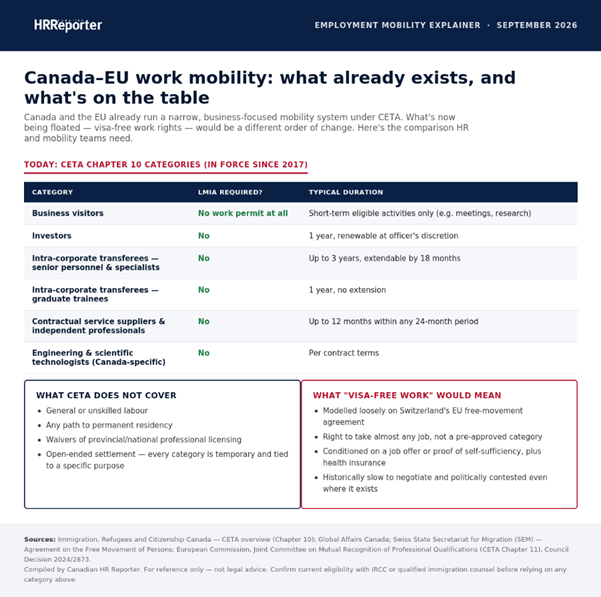
CETA's mobility provisions cover five narrow categories: business visitors, who need no work permit at all for eligible activities; investors; intra-corporate transferees, split into senior personnel and specialists (work permits good for up to three years, extendable by another 18 months) and graduate trainees (capped at one year, no extension); contractual service suppliers and independent professionals, who can work for up to 12 months in any 24-month period to fulfill a specific contract; and, in a Canadian-specific carve-out, engineering and scientific technologists.
That's useful for a multinational moving a specialist between a Toronto office and a Dublin one. It is also, by design, quite limited. CETA does not cover general or unskilled labour, doesn't create any path to permanent residency, and doesn't waive licensing or certification requirements for regulated occupations. A German engineer transferred under CETA still has to meet whatever provincial licensing rules apply in Ontario or Alberta.
(See the visual breakdown below for the full CETA category table, alongside what a Switzerland-style "visa-free work" arrangement would add on top of it.)
Why "visa-free work" is a different order of change
The closest real-world example of what Ottawa appears to be asking for isn't a trade agreement at all — it's Switzerland's Agreement on the Free Movement of Persons with the EU, in force since 2002. Under that deal, Swiss and EU citizens can take up almost any job in each other's territory without a work permit as such, provided they have an employment contract or, if not working, can show financial self-sufficiency and health insurance. EU nationals can even start working in Switzerland on a simple online declaration for stays of up to three months before needing a residence permit at all.
That is a fundamentally different design than CETA's short list of pre-approved business categories. It's closer to treating the two labour markets as one, at least for the purpose of who can show up and take a job.
It also hasn't been simple for Switzerland to maintain. The arrangement survived a national referendum in 2020 aimed at scrapping it, and Swiss and EU negotiators have more recently been discussing whether Switzerland will need to adopt parts of the EU's Citizens' Rights Directive to keep deepening the relationship.
In other words, even the model Canada seems to be pointing to comes bundled with obligations well beyond immigration policy, and it took Switzerland years of negotiation to land it in the first place. That timeline is exactly why the experts cited above expect any Canada-EU version to move slowly, if it moves at all.
The slow part won't be the visa. It'll be the credential.
Even a generous visa-free arrangement solves only half the problem for a regulated profession. CETA anticipated this: Chapter 11 set up a framework for negotiating mutual recognition agreements so that, say, a Canadian-trained accountant or engineer could have their credentials recognized in the EU, and vice versa.
Seven years in, the two sides have finished exactly one. The Joint Committee on Mutual Recognition of Professional Qualifications, which held its first meeting in 2019, adopted its first agreement (covering architects) in October 2024. Nothing else has followed it yet.
Professional licensing in Canada is provincial, and in the EU it's set at the member-state or even regional level, which means Ottawa and Brussels can encourage recognition but can't force any given provincial or national regulator to sign on.
That history matters for anyone reading this week's announcement as a signal that European nurses, teachers or accountants will suddenly be practising in Canada, or vice versa. A visa is not a licence. Even under the most ambitious version of this deal, credential recognition would likely remain the genuine bottleneck and on the only evidence available so far, it took seven years to clear a single profession.
What HR and mobility teams should do now
There's no new policy to implement yet. Associate membership, a visa waiver and expanded credential recognition are all still proposals, with the next real checkpoint being a Canada-EU summit set for Ottawa on October 29 and 30. Before then, three things are worth doing:
- Audit how much you're already using CETA. Many Canadian employers with European operations have never used the Chapter 10 categories, either because their mobility team defaults to standard work-permit processes or because nobody flagged that the LMIA exemption applied. That's a quick, current-rules win regardless of what happens next.
- Separate "easier travel" from "easier hiring" in your planning. If visa-free work does materialize, it will most plausibly extend who can show up and take a job, not automatically who's licensed to practise it. Build your workforce planning around that distinction rather than assuming one solves the other.
- Watch Ottawa for scope, not just headlines. Even the mobility experts closest to this file disagree on how far it goes — some expect a narrow, sector-specific carve-out, others see it as the start of a much bigger renegotiation of who can settle and work where. Any concrete signal about which categories of workers, and which durations, are on the table will matter far more to HR planning than the "associate member" label itself.
Read next: Ontario expands eligibility for $1-billion tariff support program