Calgary economist says labour market damage from new U.S. tariffs will reach well beyond sectors and provinces most directly hit
Nearly 90,000 Canadian jobs could be lost if the new round of U.S. tariffs remains in place — and some of the hardest-hit provinces may not be the ones facing the steepest duties, according to a new analysis.
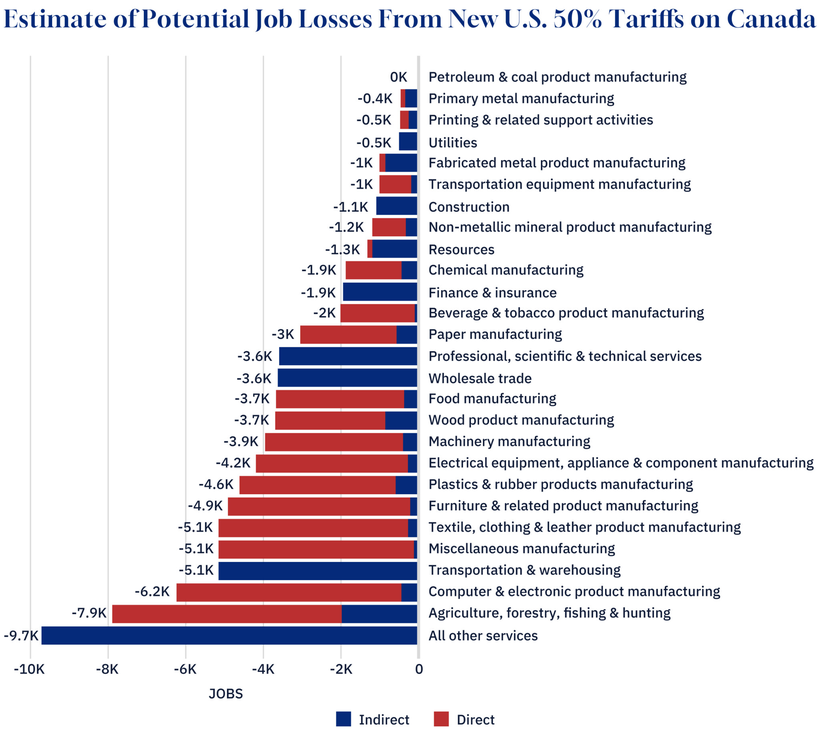
Trevor Tombe, a professor of economics at the University of Calgary, estimates that roughly 52,000 jobs are directly at risk in sectors exposed to the new 50 per cent tariffs on $28 billion in Canadian goods. Adding the indirect losses — truckers, wholesalers, and professional services firms that supply affected exporters — brings the total to just over 87,000 positions across the country, he wrote in The Hub.
On those figures, Canada's unemployment rate would climb from its current 6.4 per cent to roughly 6.8 per cent.
"The macroeconomic effects of this round may be fairly muted," Tombe wrote. "But the labour market effects are larger, and they reach well past the provinces the tariffs were aimed at."
Where the job losses fall
The pattern of job losses, Tombe wrote in The Hub, looks quite different from the pattern of tariff exposure. The new duties raise the average effective tariff rate facing Ontario and Quebec exporters by about five percentage points, and British Columbia exporters by roughly seven per cent. Alberta, by contrast, faces an increase of only about 0.5 percentage points — one-fifth of the national average.
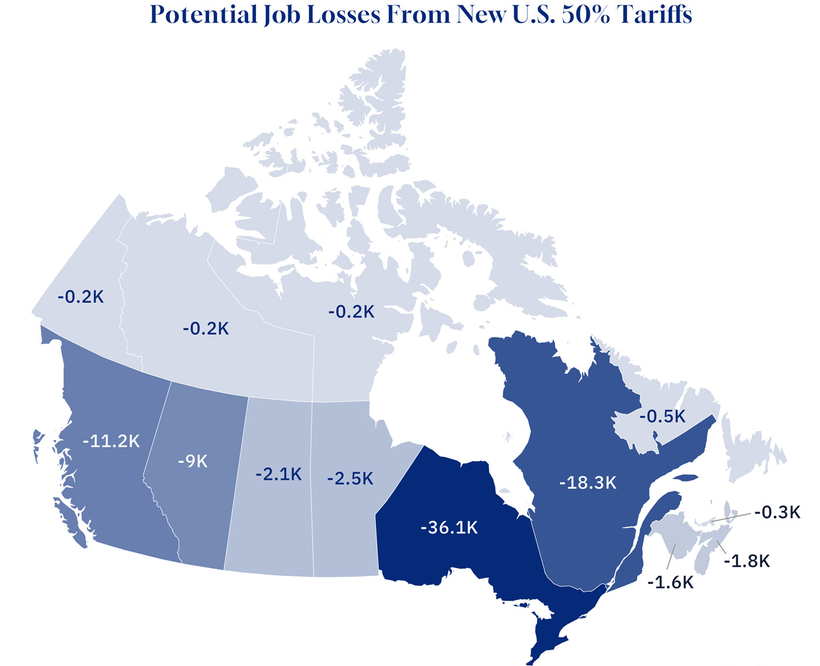
Yet Tombe estimates roughly 9,000 Alberta jobs are still at risk, because service industries that support exporters elsewhere in the country are located across all provinces. A Toronto furniture maker facing a 50 per cent tariff still uses Alberta-based trucking, accounting and logistics firms — and those businesses contract when the exporter does.
Province-wide, Tombe puts the estimated losses at roughly 36,000 in Ontario, 18,000 in Quebec, 11,000 in British Columbia and 9,000 in Alberta.
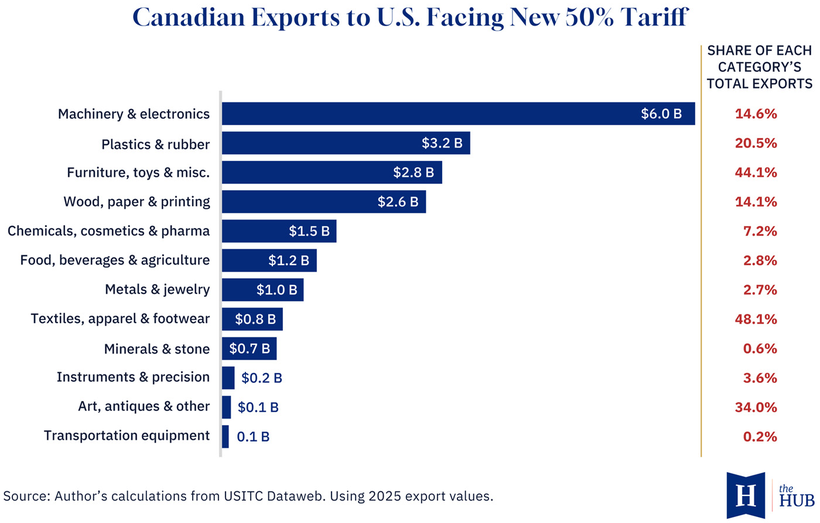
The most directly exposed sectors, he wrote, include machinery and electronics, plastics and rubber, furniture, wood products, food products and clothing. When indirect effects are added, the largest disruptions show up in transportation and warehousing, wholesale trade and professional, scientific and technical services.
Businesses already under pressure
The tariff list, reported by the Canadian Press, covers roughly five per cent of Canada's total exports to the United States and includes an eclectic range of goods: milk and cream, beer, wine and spirits, candles, hockey equipment, smartphones, video game consoles, motorcycles with engine capacity above 800 cc, furniture, clothing, gold and silver jewellery, paintings and sculptures, and antiques up to 250 years old, among others.
The Canadian Federation of Independent Business, cited by Global News, found that 40 per cent of small exporters sell products on the tariff list, and one-third of those businesses expect their sales to fall by at least half.
Matthew Holmes, executive vice president and chief of public policy at the Canadian Chamber of Commerce, told Global News the uncertainty had been accumulating for well over a year. "In 2025, there were over 52 different changes to the American tariff and tax code. That's more than one a week," he said, adding that many firms had already frozen investment decisions and delayed hiring as a result.
Geoff Stewart, founder of Alberta-based Rig Hand Craft Distillery, told Global News the unpredictability has been more damaging than the tariffs themselves. His company closed a Texas packaging facility amid tariff concerns, losing contracts in that state and in Arizona and Alaska, and has since made its first shipments to Japan. But pivoting away from the U.S. is no easy fix, he said.
"The idea that there's no tariffs today, and then in three days there are tariffs, and then seven days later, it might come off, then four days later it might come back — we can't run our businesses with that amount of uncertainty," Stewart told Global News.
Ottawa's response
Prime Minister Mark Carney, in a statement released shortly before midnight on August 21, said Canada would match the U.S. tariffs "dollar for dollar" and vowed additional support for affected workers and businesses in the coming days, building on what he described as nearly $25 billion in support provided over the past 18 months.
Carney said last-minute U.S. demands had made a deal impossible. "Last-minute changes in the U.S. proposed terms were unfair, uneconomic, and called into question the reliability of any deal," he said.
He pointed to broader economic indicators as evidence that Canada's strategy is working despite the breakdown — including foreign direct investment at its highest level in two decades and job creation running at four times the U.S. rate. "Canada has what the world wants," Carney said. "And we will not allow any nation to determine our future."