Labour force participation sinks to 28-year low, aside from pandemic in 2020: StatCan

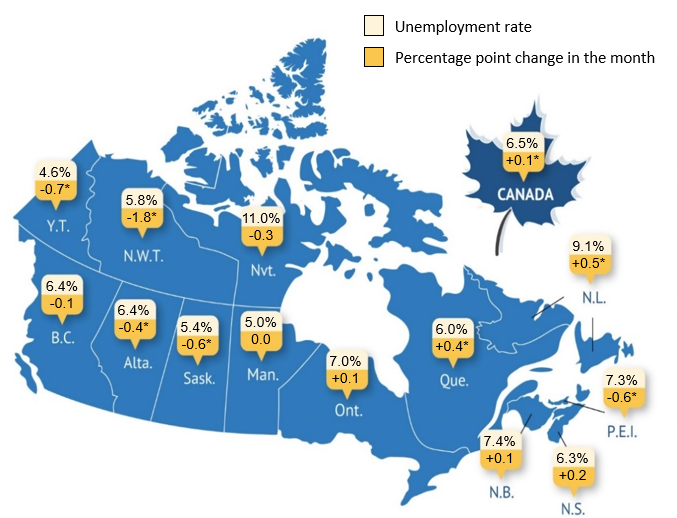
Canada's labour market lost ground for a second consecutive month in September, shedding 68,000 jobs as the employment rate slipped 0.2 percentage points to 60.6%. The national unemployment rate edged up 0.1 points to 6.5% — right back where it started the year in January, according to Statistics Canada in its Labour Force Survey.
The losses were split almost evenly between full-time (−35,000) and part-time work (−33,000). Coupled with August's decline of 42,000, the past two months have now erased a meaningful share of the 181,000 jobs added between April and July.
Still, employment remains 95,000 (+0.5%) higher than a year ago.
Aging workforce and participation rates
The participation rate — the share of Canadians 15 and older who are working or looking for work — fell 0.2 points to 64.8%. Statistics Canada attributes the year-over-year drop largely to population aging: people 65 and older now make up 23.2% of the working-age population, up from 20.5% in September 2019 and 14.8% at the turn of the millennium.
Excluding the pandemic year of 2020, Canada's labour force participation rate hasnt' been this low since December 1997.
The agency notes that a surge in immigration briefly paused that trend in 2023 and 2024, but aging resumed in 2025. Holding the population's 2019 age mix constant, the participation rate would be essentially flat on the year and slightly above its pre-pandemic level.
Youth and core-aged women hit hardest
Young Canadians aged 15 to 24 lost 48,000 jobs (−1.8%), a second straight monthly decline that brings the two-month loss to 67,000 and wipes out their spring and summer gains. Many left the labour force altogether, so the youth unemployment rate held roughly steady at 13.0%.
Among women aged 25 to 54, employment fell by 28,000 while more began looking for work, pushing their unemployment rate up 0.3 points to 5.3%. Core-aged men moved the other way: their employment held steady and their jobless rate dipped 0.2 points to 5.8%.
Average hourly wages rose 2.3% year over year to $37.64, a slight pickup from August's 2.0%. But those out of work are finding it harder to get back in: just 30.6% of people unemployed in August had found a job by September, down from 32.8% a year earlier and well below the 2017–2019 average of 36.5%. The layoff rate, at 0.7%, remained close to normal levels.
Public sector keeps shrinking
Public sector employment fell by 70,000 (−1.5%) in September, its fourth consecutive monthly decline. Over the past year the sector is down 119,000 workers (−2.6%), with most of the losses in educational services. Private sector employment was little changed on the month but is up 163,000 (+1.2%) year over year, while self-employment edged down 23,000.
Educational services lost 35,000 jobs (−2.2%) after seven months of little change, leaving the industry down 67,000 (−4.2%) from a year earlier — concentrated in Quebec, Ontario and Alberta. Health care and social assistance shed 23,000 positions, its first monthly decline since December 2022, though it remains the biggest driver of job growth over the past year (+93,000).
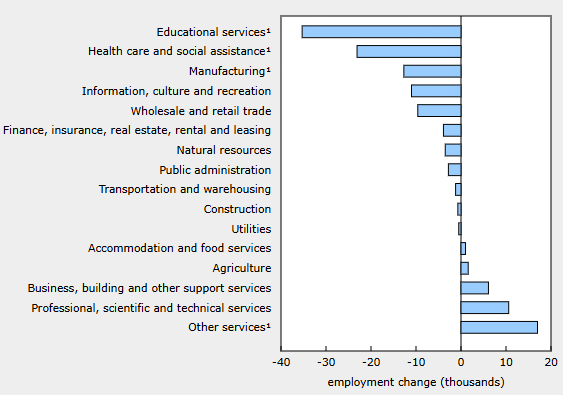
Manufacturing gave back 13,000 jobs after an August gain, while “other services,” which include repair and personal services, added 17,000.
Canadian small and medium-sized businesses (SMEs) entering the second half of 2026 had cautiously optimistic outlook, according to a recent survey.
Quebec leads losses
Quebec shed 49,000 jobs (−1.1%) in September, extending a slide that has cost the province 130,000 positions (−2.8%) since January. Its unemployment rate rose 0.4 points to 6.0%.
British Columbia lost 20,000 jobs, its first monthly decline since March, and Ontario edged down 20,000, though Ontario remains up 86,000 on the year with unemployment at 7.0%, says Statistics Canada.
Alberta was the standout, adding 23,000 jobs (+0.9%) and trimming its unemployment rate 0.4 points to 6.4%. Newfoundland and Labrador and Prince Edward Island also posted gains.