Layoff rates also down from pre-pandemic levels among short- and long-tenured employees

Canadian employees new to their jobs are voluntarily leaving work at far lower rates than before the pandemic, a decline that could reduce recruiting and onboarding costs in the first year of employment, according to a recent report.
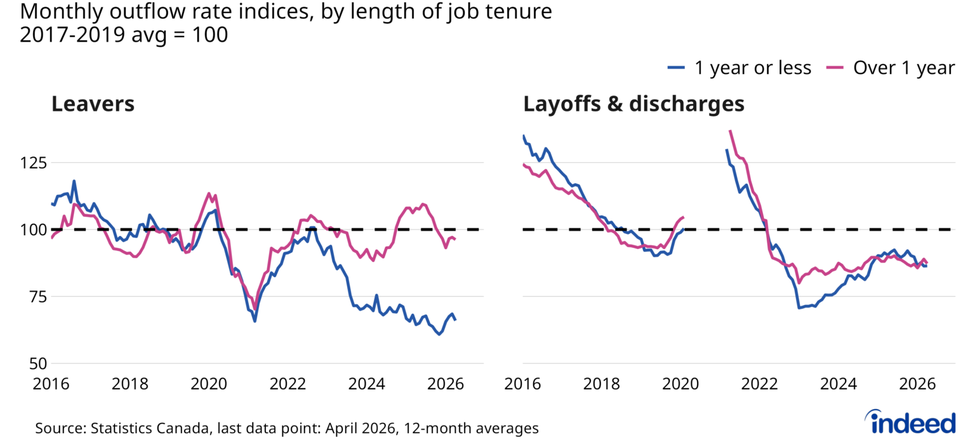
In the year through April 2026, the average monthly employment separation rate among recent hires – defined as those with tenure of one year or less – stood at 2.0 per cent, compared with 0.7 per cent among employees with longer than 12 months of tenure, notes Indeed.
The gap is driven mostly by higher layoff and discharge rates among new hires, at 1.5 per cent versus 0.5 per cent, but voluntary departures also contributed, at 0.5 per cent versus 0.2 per cent, according to the report.
However, compared with 2017-2019 averages, total outflows among short-tenured workers were down 20 per cent, versus 11 per cent for longer-tenured staff. Layoff rates fell by similar amounts for both groups, about 13 per cent, but voluntary quit rates among new hires dropped 34 per cent, compared with a four-per-cent decline for longer-tenured employees, the report found.
“It’s been harder for job seekers to find new work in recent years, but workers starting new roles are less likely to lose their jobs, or leave work entirely than they used to. The shift has been particularly pronounced among workers who’ve been with their employer a year or less, reflecting a drop in 'quick quitting,'" says Brendon Bernard, senior economist at the Indeed Hiring Lab.
“Layoff rates are down similarly from pre-pandemic levels among short- and long-tenured employees, while voluntary leaver rates have plunged among recent hires.”
Canada's labour market rebounded sharply in May, adding 88,000 jobs and pushing the unemployment rate down to 6.6%, according to Statistics Canada.
Trend spans age groups, industries
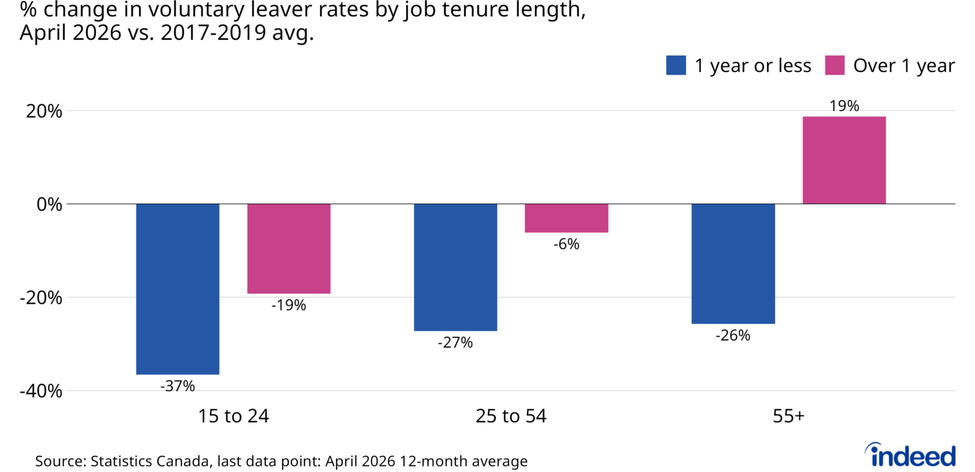
The decline was not limited to one demographic group. Voluntary outflows among new hires fell across youth, core-age, and older employees, with declines among short-tenured staff outpacing those among longer-tenured employees in every age bracket, the report found. Older workers were an exception in one respect, as rising retirements have pushed up their total outflows regardless of tenure.
The pattern also held across industries. Over the two years through April 2026, quick quitting was flat or down in 12 of 13 industries with sufficient data, with the steepest declines in sectors where it was previously most common: non-durable goods manufacturing, accommodation and food services, and information, culture and recreation.
The report frames the broader trend within the "job hugging" phenomenon, writing that it describes employees "holding on to their jobs longer than they used to." It adds that what distinguishes the Canadian pattern is that the pullback in departures is concentrated among recent hires rather than spread evenly across the workforce.
More than half (57 per cent) of HR professionals plan to look for a new job in the next six months, according to a previous report.
Drivers of turnover
The report identifies two possible drivers. One is a "pull" factor: pessimism about finding another job may be discouraging new employees from quitting even when dissatisfied. The other is a "push" factor in reverse, in which new hires may be more satisfied with their jobs than before, aided by improved information available to job seekers about openings and employer quality prior to accepting an offer.
The report also points to a direct cost implication for employers, stating that fewer new hires leaving means "less time and money spent on recruiting and onboarding their replacements." It does not draw a firm conclusion on whether pessimism or satisfaction is the primary driver of the trend.
The effect on job seekers is less clear-cut. Slower turnover among incumbent employees means fewer positions open up through attrition, which the report says could make it harder for unemployed job seekers to find work, though it adds this effect may be temporary if the decline in quitting reflects genuine improvement in job fit rather than fear of a weak job market.
Reducing quick quitting can pay off for employers in several measurable ways, based on data from Canadian and international research organizations: