‘The appetite to move is cooling along with the market’

New data shows that, among Canadian employees, the urge to move is fading faster than a year ago.
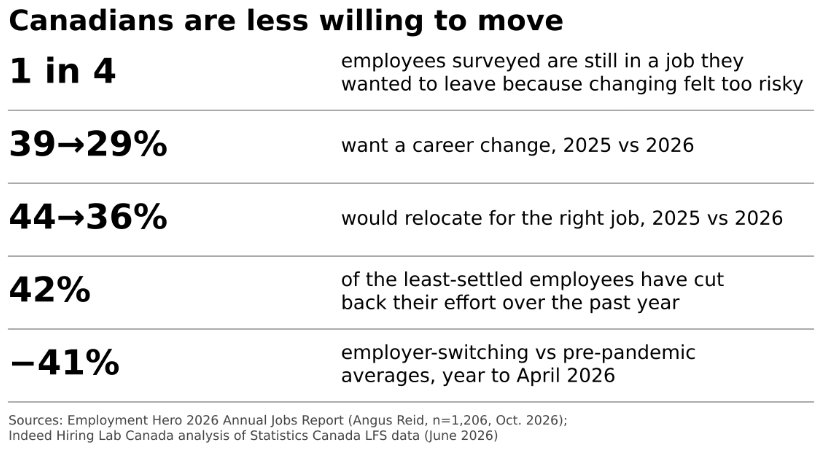
A quarter of surveyed workers are now job hugging – staying in roles they would rather leave because a move feels too risky or difficult – according to Employment Hero.
Interest in a career change fell from 39 per cent in 2025 to 29 per cent in 2026, while a willingness to relocate for the right job dropped from 44 per cent to 36 per cent. The employment platform says both declines are statistically significant, "so the shift is real, and the appetite to move is cooling along with the market”.
Employment Hero sees the same stalemate. "Canada's workforce is stuck in a holding pattern, and we need to get it moving again," says Chris Pinkerton, managing director at Employment Hero Canada.
The findings build on earlier signals. In October 2026, the MNP Consumer Debt Index by Ipsos found 25 per cent of working Canadians were reluctant to leave because of labour market uncertainty. Employer-switching was down 41 per cent from pre-pandemic levels in the year to April 2026, according to Indeed Hiring Lab Canada's analysis of Statistics Canada data.
Retention risk in Canada
The new Employment Hero report – based on an Angus Reid survey of 1,206 employed Canadians – adds a warning: among the least-settled respondents, 42 per cent have cut back their effort over the past year.
Earlier research points the same way. Only 21 per cent of Canadian employees were engaged at work in 2025, compared with 32 per cent in the United States, according to Gallup's State of the Global Workplace: 2026 report.
Eagle Hill Consulting's July 2025 Employee Retention Index reached a similar conclusion, stating: "Organizations need to make staying feel like a choice, not a default."
For employers, a quieter labour market can mask a retention risk.
"Just because they can't leave now doesn't mean that they don't want to leave," John Trougakos, professor of HR management at the University of Toronto, told Canadian HR Reporter in an analysis of how employers should respond to job hugging.
Trougakos cautions that the leverage they enjoy now is temporary. "Eventually, there will be more jobs available to people," he says.
Wages on the Employment Herp platform are growing faster than last year. Median pay growth among small and medium-sized businesses reached 4.2 per cent year over year in October 2026, up from 2.9 per cent a year earlier.
However, workers feel behind. Of respondents who got a raise, 77 per cent received four per cent or less and 56 per cent say it trailed the cost of living.
Hiring cools as headcount slips
And higher wages have not translated into more hiring. Average monthly headcount growth on the platform fell from 0.5 per cent between March and June 2026 to negative 0.5 per cent between July and October 2026.
"Employers are holding on to the people they have, but they are adding fewer," writes Lisa Cowie, global insight lead at Employment Hero, in the report.
Trust remains a barrier. Some 39 per cent suspect they have seen a ghost job – a posting for a role that is not genuinely open – in the past two years, a problem behind Ontario's crackdown on employers posting ghost jobs.