With CHROs expected to have more skills, expanded responsibilities, HR academics call for C-suite collaboration, shifting priorities, experimentation

CEOs are expecting more from their chief human resources officers than ever before. But at the highest-performing companies, they aren't spending more on HR to get it.
That's one of the central findings of a report released by executive search firm Heidrick & Struggles, which says CEOs now want their top people officers to reinvent work with AI, redesign operating models and drive transformation — all while keeping employee trust intact.
For HR academics, the findings ring true, though they may not be entirely new.
"In practice, when I'm out talking to senior leaders, yes, this is what I'm hearing in terms of the shift and the change in the CHRO," says Wendy Carroll, associate professor of management at Saint Mary's University's Sobey School of Business in Halifax. "But from a research perspective, what I find really interesting is this… has a longer history."
Today's HR leaders are being asked "to fly the plane and make sure that we don't miss any of the stops, the earthly stops, while transforming the plane into a rocket to head to Mars," she says.
More skills, more reach, same budget
The Heidrick & Struggles report draws on an analysis of 2,716 CHRO searches, a survey of 600 HR leaders at companies with at least $1 billion in revenue across 11 markets, and conversations with CHROs.
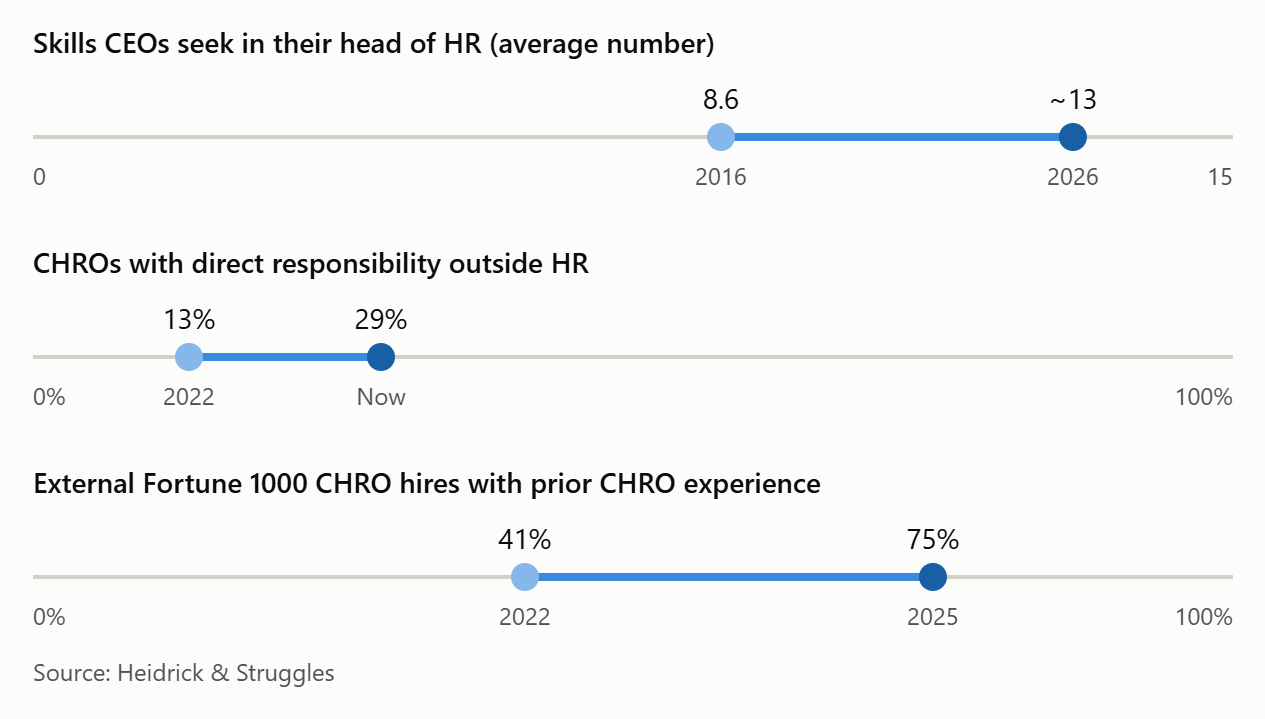
The number of skills CEOs want in their head of HR has climbed from about 8.6 in 2016 to nearly 13 in 2026, the report says. In 2022, 13 per cent of CHROs had direct managerial responsibility outside HR; that share is now 29 per cent, covering areas such as enterprise transformation, communications and workplace strategy.
And 45 per cent of Fortune 1000 CEOs have specifically tasked their head of HR with a lead role in their organization's AI transformation.
Yet the highest-performing companies aren't funding HR any more generously. Heidrick & Struggles found no statistically significant difference in HR-to-employee ratio or HR spend per employee between companies with high total shareholder return (TSR) and those with lower TSR relative to industry peers.
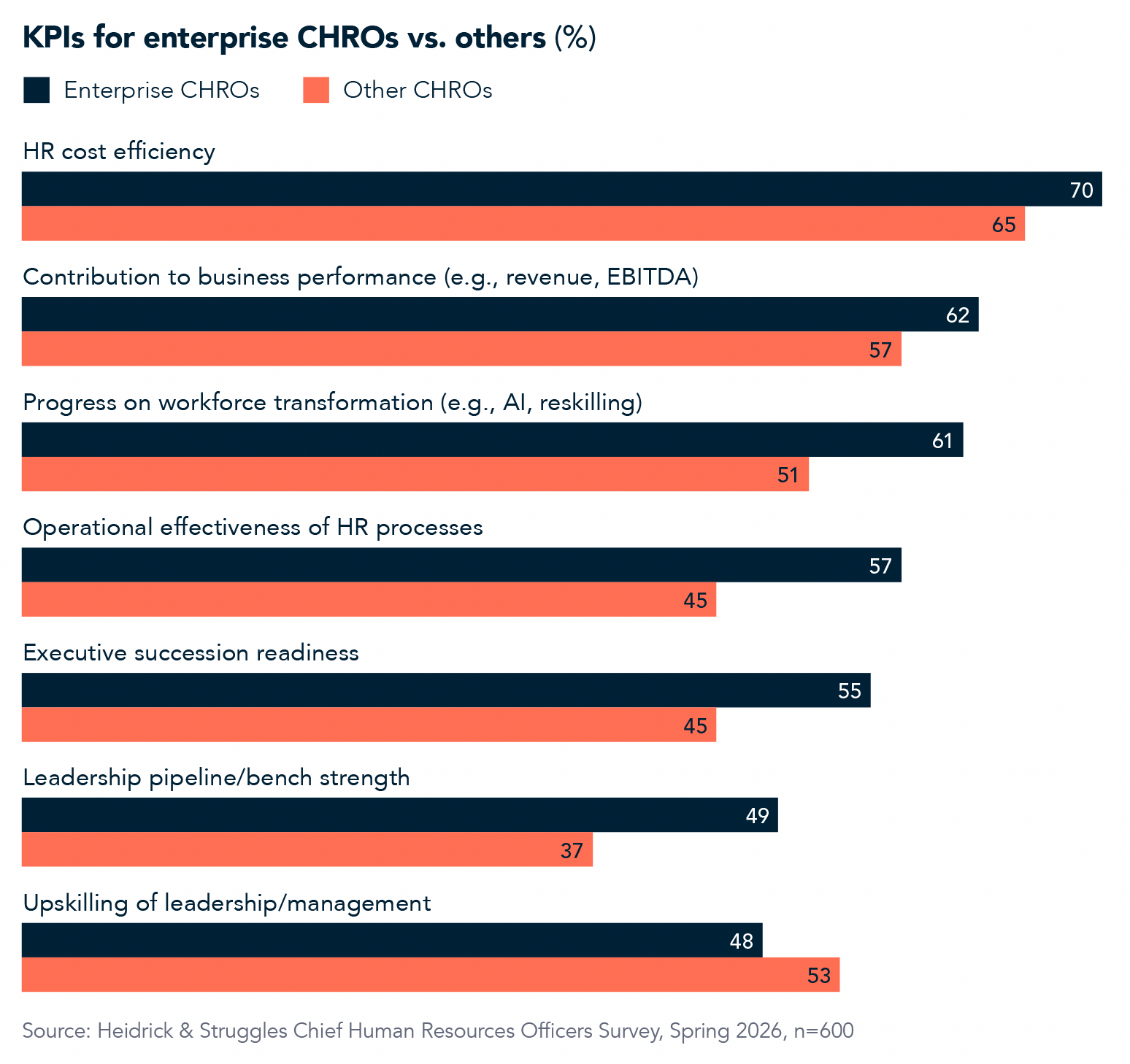
Instead, the report says, top performers are more likely to have what it calls an "enterprise CHRO," a leader with strong core HR operations, advancing capability in workforce planning, succession and AI workforce transformation, and strong alignment with the CEO.
However, only 25 per cent of CHROs operate at that level, it says.
Same questions, new answers
Marie-Hélène Budworth, associate professor in the School of Human Resource Management at York University in Toronto, doesn't see a fundamentally different skill set at play. Rather, there's a different emphasis on how CHROs must be experts because of the changing landscape of work, she says.
"We’re still talking about some of the issues we've always been talking about, like ‘How do you prepare people for work of the future? How do you prepare leaders? How do you align HR with strategy?’ Those are the same questions,” she says.
“It's just that the way in which we're doing that is going to shift a fair amount with the way jobs are evolving."
The biggest change, in her view, is the role of job design. Flexible work, a legacy of the pandemic, and AI's impact on which tasks need to be done by humans have made it central to how the business runs.
"One of the things that's quite clear is that there's an increasing need for job design as a core to the HR function," says Budworth. "It's always been a part of HR, but there's a shifting emphasis."
That means HR must be involved at the very start of business planning, she says. "It has to happen earlier and in tandem with the business plan, as opposed to in response to the business plan."
A 30-year arc
Carroll says the idea of HR as a strategic driver isn't new, she says. "The history actually goes back over 30 years."
She points to research by Mark Huselid in the mid-1990s, which linked high-performance HR practices to lower turnover, higher productivity and better financial performance in a national sample of nearly 1,000 firms. That research found when organizations had a more strategic orientation, they were able to achieve higher levels of performance," says Carroll. "One of the underlying logics is that people are a competitive advantage."
Dave Ulrich then framed what the role would look like in the late 1990s: strategic partner, change agent, administrative expert and employee champion, she says. That work fed the push for HR to get "a seat at the table" in the early 2000s.
Older orientations, which she describes as personnel and traditional human resource management, are "very transactional," and they still exist. "Even though it's 2026, we may have firms that still act very much like personnel — hire, fire — versus those that are in the strategic human resource management space."
"Long story short, when I read this, I'm actually thinking, ‘Oh, the time has come where more organizations now see the need to move into this space,’" she says.
From triad to quartet
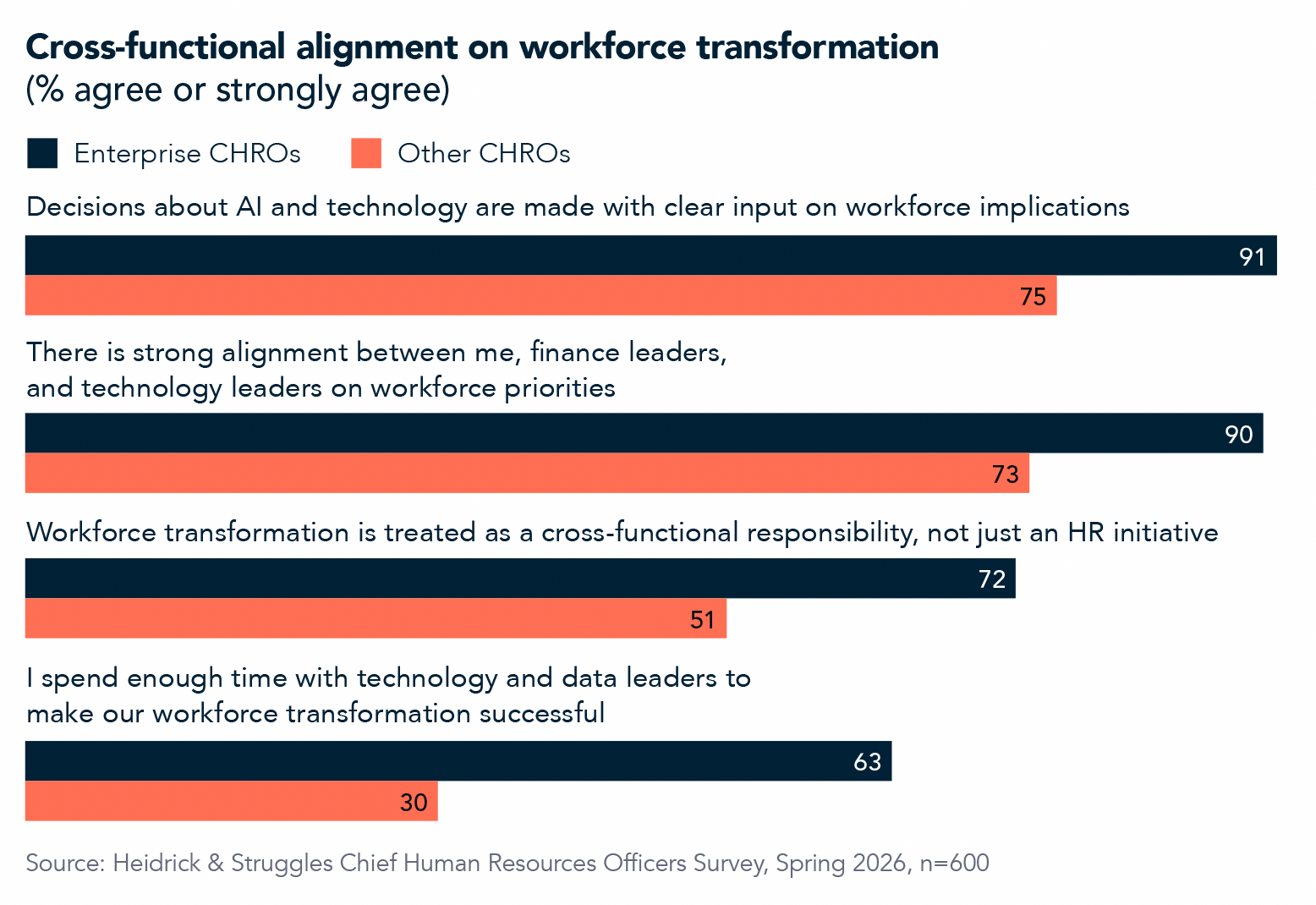
The report argues that the traditional CEO-CFO-CHRO triad is becoming a quartet that includes the senior technology leader, the CTO. Enterprise CHROs spend 10 additional hours a month working directly with their CTO on the AI transformation of work, it says, and 90 per cent report strong alignment with their CTO, compared with 73 per cent of other CHROs.
That relationship makes sense to Carroll. "[It’s about] the demands of having an AI strategy and thinking about what that looks like, how we move it into our workflows without creating jeopardies or risks, that they have to work very closely together to do that," she says.
More broadly, she sees growing pressure on executive teams "to be highly collaborative and to respect each other's domains and disciplines." Organizations already operating in a strategic HRM model have tended to be more collaborative at the top, she says, and that's part of what makes them effective.
"They can't be competitive spaces. They have to be collaborative in order to be able to move through them."
For Budworth, the case for those partnerships comes back to planning.
"We're not in a space anymore where we can just say, ‘We need a bunch of people to do this type of work and a bunch of people to do this type of work.’ There needs to be much more thoughtfulness and integration about how we plan and design work, and it needs to be done along with the business plan, not in response to the business plan.”
The AI gap facing HR
According to the Heidrick & Struggles survey, 78 per cent of CHROs expect preparing the workforce for AI and technological change to be among the most critical issues for their organization's success in the near future. Only a quarter say they're effective at it today.
Budworth also expects HR to take on a bigger role in the ethics of AI.
"There are lots of places where if there isn't a human involved, a human oversight, we can run into all kinds of ethical or similar problems," she says. "So, I think there's an increasing role for HR to have oversight over ethics and responsibility."
However, Budworth doesn't think organizations have figured out job design for AI yet.
"I think we're still struggling," she says. "AI is still evolving and because the way we do work is so we're so entrenched in our systems that I don't think we have a clear idea of where we're settling."
Carroll isn't surprised by the gap either.
"I don't think we have a lot of answers to the question. I think we're doing a lot of experimentation in organizations. Some of it's working out, some of it's not working out."
Organizations are still working through the tension between automation and augmentation, she says, and every context is different. One organization's enterprise system may be mapped quite differently from another's, so lessons don't always transfer.
"I would think that they're probably not feeling as effective because we end up with more failed experiments… until we get it right. And that can take a bit of time," says Carroll.
Experience on day one
Boards and CEOs are also looking for more seasoned CHROs. Among externally hired Fortune 1000 CHROs, the share with previous experience in the role grew from 41 per cent in 2022 to 75 per cent in 2025, according to the report. The share with experience in the same industry rose from 23 per cent to 34 per cent.
CEOs want someone who will be contributing on day one, not learning on day one, the report says.
Carroll, who takes an evidence-based management approach, is cautious about reading too much into experience on its own. "Sometimes we can say we have 20 years of experience, but if it's 20 years of the same type of experience, I may not have what it takes to operate in this particular kind of environment," she says.
"If someone has come up through an organization and they're technically good and administratively good, but they may not have the kind of skills that you need for the strategic partnerships and the kind of enterprise view, then that is more difficult to train."
That's why an external search can make sense for some employers, says Carroll. "If you have an organization that has predominantly come from a personnel orientation, you may not have someone who's moved up through those ranks who can do that."
Budworth says the internal-versus-external question is a familiar one.
"As with any type of leadership development, there's a benefit to each," she says. "There are moments where bringing somebody from within is great, and there are moments when hiring externally is great. I think this is much more nuanced than ‘Here's the best practice… for hiring CHROs.’"
When CEO support falls short
With the report's finding that top performers don't spend more on HR, how can HR leaders better prepare or respond if CEO supports are lacking?
Budworth says that taking on significant new roles without additional resources will be challenging, and HR will need to advocate for different types of expertise on its team, the same way any function secures resources: by building a business case tied to strategy.
"I don't think it's a hard case to make, but I do think it's one that HR will be forced to make in the coming years as we adapt," she says. "There's probably a point at which it'll be overtaxed and we'll need to think about either growth or expanding the type of development people within the HR role get."
What that looks like will vary by industry, she adds. "Some have been living in this space for a very long time and others are still figuring it out."
Carroll’s advice starts with transparency, meaning an open conversation between the CEO, the CHRO and the rest of the leadership team about where the organization has been to help set realistic expectations.
Where that conversation isn't possible, she suggests CHROs identify the most important priority and carve out a targeted pilot to show results, rather than attempting an organization-wide overhaul.
"There are no plug-and-plays," says Carroll. "That means we all need to come into the room and understand what the best available evidence is and then try to move ourselves forward with that."
She also urges patience. Drawing on Adam Grant's work on original thinkers, she notes that research has found first movers fail at a higher rate than those who improve on others' ideas.
"One of the things that I personally believe is that slow is fast right now and that there's a bit of time for pause."