
With the boom of virtual communications during the pandemic, does business travel still make sense?
“The bottom fell out, the business just collapsed,” says Brian Robertson in talking about the travel industry when the pandemic first took hold in the spring of 2020.
Since then, there have been slight upticks followed by further restrictions. And now?
“Now it’s worked its way back... because of the rollout of the vaccine, and the testing and tracing and everything that it had last year,” says Robertson, president of Direct Travel in Toronto.
“For a while, it’s going to be in a real up-and-down situation, but I think as most major business markets, with their populations activated, that the demand is going to be there.”
As for employers, “they’re deciding that it’s time to start travelling... there’s a lot of positivity. But, boy, it’s been a long, long road,” he says.
Things are starting to open up, restrictions are starting to ease, and as more vaccinations start rolling out, and we start hitting those government thresholds, there will be more opportunities for things to evolve better, says Nancy Tudorache, regional vice president for Canada at the Global Business Travel Association in Toronto.
“It’s just a matter of time, that’s all it really is right now,” she says. “But there is the demand there and corporations are looking at and planning for what that return to travel is going to be and what it’s going to look like. Certainly, it’s going to be different.”
Virtual versus face to face
Of course, with the massive rise in Zoom calls throughout the pandemic, many people are wondering just how strong business travel will come back considering the power of virtual technology.
Eighty-two percent of business trav-ellers and 79 percent of travel decision-makers say the benefits of in-person meetings outweigh the convenience of virtual participation, according to the Amex surveys in April.
Four in five (79 percent) travellers prefer in-person brainstorming and collaborative meetings over virtual ones, as well as in-person sales meetings over virtual ones (78 percent), found the two surveys of 1,032 U.S. business travellers and 504 U.S. travel decision-makers.
While video conferencing and technology can help drive remote collaboration and efficiency, says Patrick Doyle, president and general manager of American Express Global Business Travel Canada in Toronto, it has also “reinforced the importance of getting in front of clients and getting in front of colleagues. There’s no replacement for pitching to a customer in person to close a deal or to be in front of a colleague to help brain-storm an idea.”
Travelling for business is important, he says.
“We like to call it a force for god. It fuels growth, it helps people build culture, it develops people personally and professionally, helps retain talent. And it helps build relationships. There’s no substitute for in-person connections.”
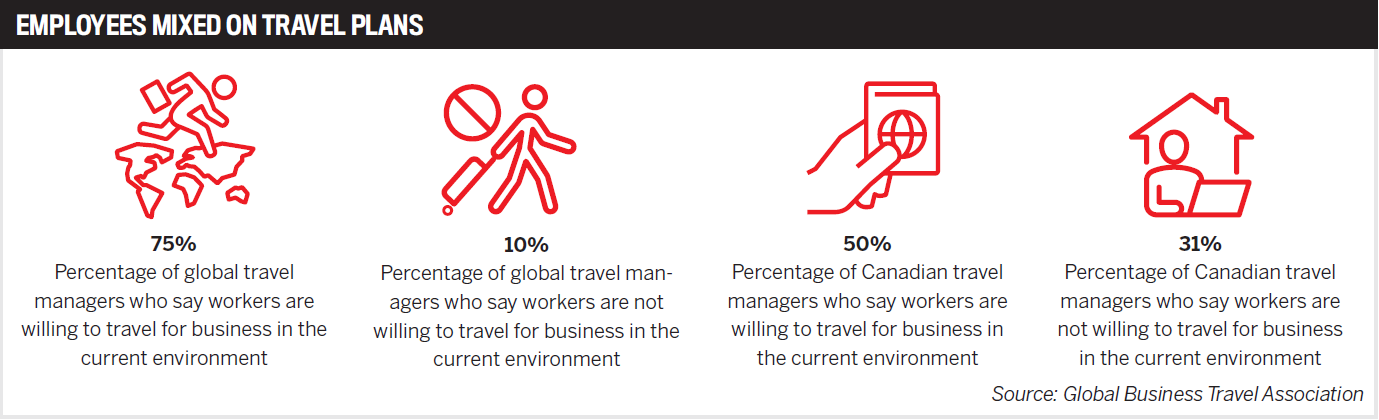
When the GBTA asked business travellers what types of meeting they found most effective for acquiring new clients or accounts, 60 percent said face-to-face meetings, while only 11 percent cited video teleconferences, says Tudorache.
“To really get deep into what business needs are, you can’t just continue to rely on technology and virtual communications all day long. We know that face-to-face meetings are essential for collaboration; they’re essential for strengthening company culture; they’re very important for conducting general business with customers, for sales acquisitions... and building relationships.”
ROI takes on new importance
In the past, people took travel for granted, so budgets were built each year based on historical trips, engagements, conferences or meetings, and access got easier as policies evolved along with the awareness of business travelers, says Tudorache.
“Now, we’ve had to push a bit of a reset button as an industry, and companies are looking at it differently. And they are having some very measured, calculated approaches on what is the ROI for their organization.... We’ve seen companies really take that step back and assess it. Fortunately, it is still, by and large, an important factor and... it is essential to their business.”
“That’s something that’s really important for companies to take a look at and understand: does it make the most sense from a cost and relationship and revenue generation perspective?”
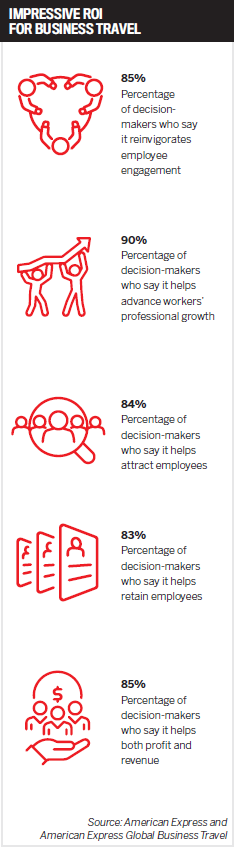
A U.S. survey found that more than four in five decision makers surveyed said that business travel leads to higher profit (85 percent) and revenue (85 percent). Many (87 percent) also say it’s a way to reinvigorate employee engagement, it helps advance employees’ professional growth (90 percent) and it is important to attract (84 percent) and retain (83 percent) top talent.
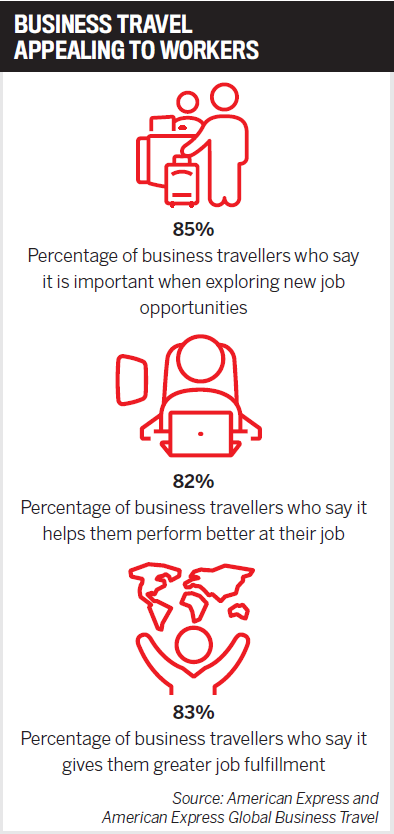
As for business travellers, 85 per cent say when they’re exploring new job opportunities, the ability to travel for work is important. Travel also plays a valuable role in their professional development, helping them perform better at their job (82 per cent) and giving them more job fulfillment (83 percent), found American Express and American Express Global Business Travel.
But there are still risks with the coronavirus, and having employees travel the world, says Andrea Lekushoff, president of Broad Reach Communications in Toronto.
“Employers will need to consider, number one, whether they need to send their employees to travel, because as we’ve seen... we can carry out business via Zoom; we can sell via Zoom; our entire sales cycle has adjusted to this new way of working. Our entire way of running our companies has worked in many cases throughout the pandemic.”
Employers should really consider whether travel is absolutely necessary, she says.
“Are they actually losing business because they’re not travelling? And if they’re not, why expose their employees, why stress out perhaps their employees and their families, and why not save on their bottom line by continuing this way of doing business?”
“Think of the efficiencies and the benefits to the bottom line of actually not having to pay for that travel of the employees, being able to focus on other work, instead of travelling for an entire day, and being exhausted the next day and not being able to be as efficient.”
The collapse of travel through the pandemic has given leaders an opportunity to question their processes, says Lekushoff.
“Business travel happened because that’s just the way we did it; incentive travel happened because that’s just the way we’ve done it. And maybe [now] it’s an opportunity to look at what’s important... and maybe we’ll find that there are other ways to motivate and other ways to build teams and bring them closer together.”
Taking a hybrid approach to travel
As the market gets competitive, people will be compelled to go back out on the road and meet face to face because they build the best relationships that way, says George Ferguson, senior analyst of aero-space/defense and airlines at Bloomberg Intelligence in Princeton, N.J.
However, when it comes to intracompany work, some employers are looking at having people come into the main office say twice a year instead of four times, so they’re cutting back a bit, he says.
“I think you’ll see, coming out of the pandemic, some lingering concerns about even the face-to-face business travel between companies and conventions, and I think you’ll see hybrid conventions... where some people will be tuned in by video and others will be live.”
A lot of companies are taking a hybrid approach to meetings and conferences where a company will plan an event and then a certain level of employees or clients or suppliers go live to the event, while others participate virtually, says Robertson.
“Companies are saying, ‘OK, we’re going to use this so we can get to more people, but as soon as we can, we’re still going to meet face to face for our board meetings’ or ‘We’re still going to meet for our sales conferences’ or ‘We’re still going to meet for our incentive trips.’ That’s what people are planning.”
Vaccine and quarantine questions
Of course, big questions still linger when it comes to vaccines. Will they be a necessity for business travel? What if an employee refuses the jab? Will they only be required for certain destinations?
HR policies are really going to have to come into play for travellers, and with the opportunities for people to be fully vaccinated, a lot of those restrictions are going to change, says Robertson.
“Obviously, that’s going to have to be up to the company culture or the HR department, as to whether [a vaccine is] required or not.”
Another consideration: what happens if an employer plans an offsite retreat that requires travel, and some employees aren’t vaccinated? Will they still be able to participate, asks Lekushoff.
“What does that say about their progression within the company? How will they be promoted? How will they be seen within the organization? They’re an integral part of the management team or the leadership team, and yet they’re not able to be with the leadership team as they’re charting the course for the coming year or making the most important decisions for the company.”
Leaders need to be super clear right now about what they’re expecting of their employees.
“Are they expecting them to have the vaccine? Will you require your employees to show some sort of vaccine passport? Can it constitute as discriminatory if they don’t? What kind of exceptions are you going to consider?” she says.
“As a leader, are you going to set the tone? If you require, let’s say, your sales team to travel, but you as a leader are not travelling, what about your leadership? If you say, ‘Hey, you can work from home, you don’t need to travel,’ and your client demands that you travel, where does that lead? What does an executive do at that point?”
In the near term, it’s likely employers will have to adjust some of their policies for how they’re letting people get out on the road, and where they’re going, says Ferguson.
 “Over time, that will get peeled back... I would hope that the vaccination spreads to the four corners of the earth, there’s some sort of immunity that’s built, we figure out who’s all in the most at-risk camps, and then we get back to something that’s very similar to what we used to be — maybe not exactly, but pretty close.”
For now, in the United States, employers may run into personal disclosure issues in asking employees if they have been vaccinated, he says. On the other hand, employees could voluntarily show proof of vaccination, and that should make employers more comfortable with the idea of sending them out on the road, he says.
“I feel like there’s going to have to be a dual regime of ‘Show us a vaccination’ or ‘Be willing to take a test that shows that you don’t have the coronavirus.’”
There is also the challenge of quarantine when people return from a trip away, says Ferguson.
“I don’t think it works well; people don’t like to do it. When they’re not compelled to do it, they won’t do it. And so, I think that quarantine will be hard to include inside those [travel] policies, but testing may well be, and then staying away from the office to get tests.”
Even if quarantines are reduced or eliminated, people may still have to be tested when they return to the country for the foreseeable future, says Robertson.
“So, what does an employer do with their travellers for the three days until they get their test results back? You probably can make a virtual workplace available for that. I can’t imagine many employers are going to allow travellers — certainly international travelers — to return from an international journey, have a PCR test and return to the workplace, at least the office workplace, before they get the test [result] back. So that’s a fluid situation as well.”
Best practices for the new world of travel
 While employers and HR professionals might be able to find out current information about travel restrictions and policies on airline or government websites, a travel management company would also be helpful, he says.
“And companies, who in the past didn’t necessarily put a high priority on duty of care now, because of the pandemic, have certainly put a high priority on duty of care and making sure that everybody is aware of the current situations at the destinations that their travellers are going to.”
While people in essential services, such as engineering, bioscience and government have been travelling throughout the pandemic, they’ve had to deal with the various restrictions and protocols, says Robertson.
“And it’s had to be a very fluid situation, because it’s been changing all over the place. One day, a country’s got one set of rules; the next day, a country’s got another set of rules. So, our travel advisors have had to learn how to adapt and manipulate the system to get people to the destinations, or, more importantly, in a lot of cases, to get them home from where they are,” he says.
“We had this happen a couple of times in the Netherlands, where Amsterdam is a very popular place of connecting for international travellers, and they just all of a sudden added another test.”
The key is understanding where your employees are and being able to get in touch with them, says Doyle.
“The reporting and communication that you’re having with travellers, should something change, is critically important.”
There are online solutions and apps that allow for that two-way communication and last-minute emergencies, he says.
“[It’s about] ‘How do we get them out of a country if something’s changed?’
And those are factors that will change; it’s going to be fluid as countries open up or close.”
Employers should also understand that travel is very personal now, says Tudorache, and employees need the right tools and resources.
“It’s no longer just about how many points you can get on your loyalty rewards when you fly; it’s about really, truly satisfying the individual’s personal level of confidence.
It’s also about making sure that the companies have a duty of care policy that supports them through their entire journey, from start to finish, she says.
“From there, it’s the knowledge sharing — the current knowledge around the ever-changing restrictions, the policies, the health protocols. Whether it’s a domestic traveller or crossing borders, companies need to be on top of all of the completely changing dynamics that are here today.”
On the backend side, it’s also important to make sure they’ve got a program that has preferred suppliers that are well-vetted — be it hotels, airlines or car rental companies — “make sure that they have the right policies, procedures, cleanliness, sanitation protocols... whatever is relevant at that time,” says Tudorache.



