'Communication does have a serious effect on your willingness to continue working': academic on why two-way, consistent internal communication is crucial for retention

A new global study from Staffbase and YouGov reveals a stark divide in how internal communication is experienced by different groups of workers; according to the 2025 International Employee Communication Impact Study, only 9 per cent of non-desk employees are very satisfied with internal communication.
In contrast, 47 per cent of desk-based employees report being very or rather satisfied with the quality of internal communication, Staffbase reports, warning that “this erosion of trust, fueled by poor communication, poses a serious threat to organizational stability and employee engagement.”
Jelena Zikic, associate professor of human resources management at York University, says the issue goes beyond surface-level satisfaction to the core of employee belonging – and ultimately, retention.
“Internal communication really focuses on how the employer communicates,” she says.
“That has a huge impact on how well I feel going to work, how much I enjoy my organization. Think of an organization as a communication partner. If I feel I don't know enough about the place where I'm spending all this time, it will impact how much I enjoy working there and how satisfied I am.”
Turnover, trust and the importance of two-way communication
The Staffbase report outlines that not only is internal communication a matter of morale or engagement, it’s a key reason people stay put or leave an organization. According to the report, 63 per cent of employees who are thinking about quitting say poor internal communication is a significant reason.
“Retention has to do with, in addition to how satisfied you are with the type of work or with your compensation, with relationships at work, it also has to do with just feeling belonging, feeling that you're part of this organization, you're part of this group and you know what's going on and you are included,” says Zikic.
“If we consistently feel that we're not being informed … and there are things happening in the organization that sort of are a surprise, you may eventually feel that ‘You know, why should I stay in this organization when I'm not included. So communication does have a serious effect on your willingness to continue working in a particular setting.”
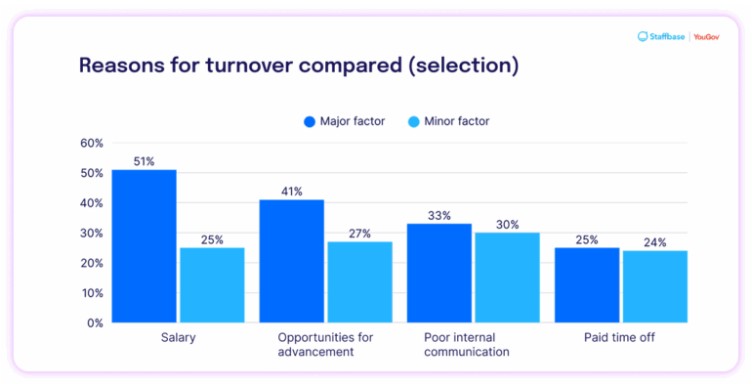
Source: Staffbase/YouGov
Staffbase’s numbers back this up: when it comes to feeling heard, 52 per cent of desk-based employees say their feedback is considered during change processes, but just 39 per cent of non-desk employees agree.
Zikic stresses the need for real dialogue, and most importantly, the opportunity for employees to respond, as for more information and ask questions.
“Communication is a two-way process, so the starting point is whether non-desk employees – or any employee, for that matter – knows enough, is getting enough information in real time, whether it's change or crisis, or anything else going on. We need to have channels where employees will have a chance to voice their opinions and to sort of have a way of sharing their thoughts. Or even if it's asking questions, give me more information, or I'm not sure I know what's going on, etc. But allowing for that channel as a two-way communication.”
Addressing loneliness and building belonging
The Staffbase report also found that 10 per cent of employees feel lonely at work always or often, and another 23 per cent feel lonely sometimes. Only 20 per cent of employees feel their employer does a very good job of helping people connect at work.
The study pinpoints supervisors as a crucial link in internal communication chains with 57 per cent of employees saying they trust them “a great deal.”
For Zikic, using multiple channels of communications is important in reaching all employee groups equally. It can also lead to inconsistency of messaging.
“One thing that we know from organizational communication is that consistency in messaging is very important,” she says.
“If you are using multiple channels, let’s say intranet message, instant messaging or mass email communication, whatever an employee chooses, there should be consistency so that all employee groups and all messages are transmitted equally to everybody.”
The data shows that employees who rate their internal communication as “excellent” or “very good” are less likely to feel lonely at work.
Moving forward: multi-channel, in-person and digital strategies
The Staffbase report recommends investing in mobile-friendly platforms, tailoring content for frontline workers, and making sure leadership communicates regularly and consistently. Zikic adds that to avoid a proximity gap, in-person communication must be a part of the program.
“As much as in-person communication sometimes may require more time or may even be harder to organize to get everybody in the same place at the same time, I would say that as leaders, managers, supervisors, this is a critical aspect of communication,” Zikic says.
“You cannot just rely on online or virtual communication, even though we're so used to working in this new way. So multiple channels, but definitely keeping and creating forums in some way, of meeting your employees in person, one-on-one, as well as a team.”