
New director of mental health at EllisDon looking to enhance psychological health and safety in construction
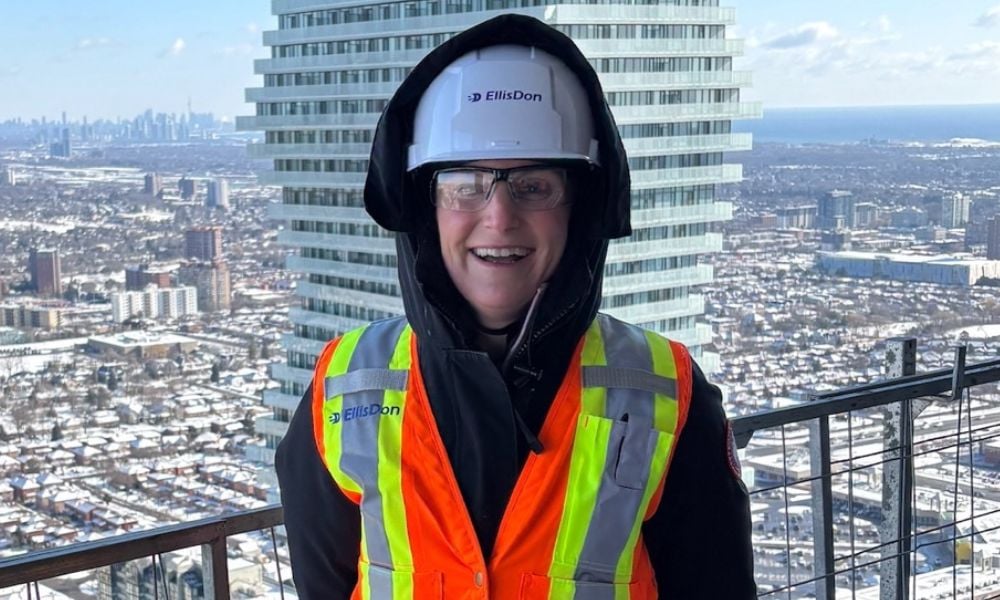
Three months into her new role, Connie Ellis is still catching her breath: “It’s a lot of drinking from a fire hose, it’s a lot of understanding the culture… [and] integrating myself. So, it’s been a lot — but fun.”
As EllisDon’s inaugural director of mental health, she’s navigating a steep learning curve in an industry she never expected to join — but one that’s familiar all the same.
“I come from a family of what I'm learning they call the ‘guys on the tools,’” Ellis says. “My dad is a mechanic; my brother’s a heavy machinery mechanic… [but] I had no idea about everything behind it.”
She has a solid background in the health care industry, having worked at organizations such as TELUS Health, CAMH, St. Joseph’s Health Care and Collegiate Psychological Services, and an ambitious agenda for her job job: Expanding the scope of the existing mental health team and leading the strategy to enhance psychological health and safety across EllisDon.
Stigma, isolation in trades
The need to focus on mental health in industries such as construction, oil and gas or mining is not new, but is increasingly important. Reports of depression, anxiety and stress are elevated in these industries, while stats show that rates of suicide are also higher.
For that reason, understanding the physical and mental demands of the job is key in order to address them.
“Systemically, you have this industry that isn't necessarily aware of the factors that put them at risk,” says Ellis.
At every organization – no matter the sector – stigma is an issue when it comes to discussing or revealing mental health concerns, she says, but it is different in the trades because of the severity.
“You have a predominantly male industry — so that stoic, macho, ‘I don’t need help’ [attitude].”
There are social norms that men still abide by, especially in the trades, agrees Kathy Martin of the Infrastructure Health & Safety Association (IHSA).
“[It’s] about having to display a toughness; that macho bravado is still very alive and well in the trades, and that leads to higher stigma and folks not seeking help.”
Long hours add up in skilled trades
There are also a lot of workers in the trades who work long hours and travel long distances to a job site, sometimes staying away from home for weeks, says Martin, coordinator of research, stakeholder and public relations, mental health at the IHSA.
Your employer is often your union, she says, so people are called out to different work sites and have a working relationship with the contractor or constructor on that project — and then they leave.
“You're just a piece of a big puzzle… and it causes a lot of barriers, quite frankly. And so people are traveling a lot. You're not stationed in one place. Your co-workers are changing on a pretty frequent basis.”

Kathy Martin
And with long hours of 12- to 14-hour days, it's hard to stay mentally well and physically well, says Martin.
“I think it sets people up for failure.”
Learning early about mental health
Another consideration? A lack of psychoeducation when people are younger, says Ellis.
“You have a lot of people who, whether they went to school or no, didn’t necessarily take Psych 101, so just understanding the basic principles of what I refer to as the mental health spectrum.”
Even for engineers, for example, unless they take an interest in a minor or an elective in psychology, they just don't learn about this issue, she says.
“You just have to remember, with every generation, every culture, every industry, you're still educating people who have never touched the subject. So, that's something I remind myself almost every day.”
Even with apprenticeships, people should better understand the realities of the work environment, says Martin: “Not just the skills of the job, how to do the job safely, which is critical, but they also need to have a really good understanding of the environment they could be walking into, and how to prepare for that.”
It’s not only about coping skills, she says, “but also how to reach out for help, both within the workplace and within the community, because let's be honest, they may not find the supports within their workplace.”
Substance use in skilled trades
Unlike many mental health roles typically embedded within HR, Ellis reports directly to the SVP of safety — a decision that, in her view, sends a powerful message: “Here it is as prioritized as a safety [issue] so we are part of that team.”
Given the long hours, remote work and physical demands, many trades workers cope through substance use, she says, highlighting the need for “conversations about prioritizing our health — not just our physical, but our mental, our psychological, whatever you want to call it.”
So, it’s largely about raising awareness, says Ellis.
“I’m not trying to change the culture; I’m not trying to go around and tell people to stop drinking — it’s just ‘Be aware: Are you recognizing when you’re not sleeping? Are you recognizing the impact?... Are you recognizing when maybe you are not feeling your best self, and you are drinking more than usual? And do you have a good social network?’”

The substance use can extend to harder drugs such as cocaine, crystal meth and opioids, which has a lot to do with the culture, says Martin.
“And when I say the culture, it’s more the wear and tear on the body and the expectation of ‘Work hard, play hard, get up and do it again, repeat.’”
These hard drugs will pick people up, energize them to get through the day or help bring them down at the end of the day, she says.
“So, pain management is something I've been talking a little bit more about with workplaces as well, that they need to build that into their wellness planning, their support system — you can't expect people to keep going and not break.”
On-site conversations about mental health
Given all these challenges, what steps are truly going to break through and resonate with troubled workers? Ellis says she has several strategies on the go, including meaningful conversations and leadership training.
One of the best ways to decrease stigma is by having very human conversations, says Ellis.
“I think people get stuck on semantics: ‘Oh, nothing's wrong with me.’ Or you hear people go, ‘Lots is wrong with me.’ But these are really what makes us human, just very honest... complex and interesting conversations.”
Ellis admits there may be skepticism among workers about the necessity to focus on mental health, or resources available.
“But what's really interesting is when there's a critical moment — so when there's a fatal or near fatal incident or significant near misses… you're almost welcomed.”
She is also making a point to visit construction sites to have conversations around mental health with employees and contractors.
“I just went to a safety moment today with about 170 subcontractors. So... 20% of them, typically, will be struggling, and if one of them was able to access a resource today, because they really are, or their family member is, then I've done my job,” she says.
Making it ‘normal’ to share stories
Ellis also says she tries to “play on” the skepticism of the workers to break the ice.
“There's been times when I've been in a room where there are so many guys, and I'll say, ‘Okay... I want everyone to reach and hold their partner's hand beside them.’ And then I'm like, ‘I'm just joking’ because they think this is going to be some emotional mumbo jumbo.
“What they don't realize is that I'm going to be talking to them about exactly what they're struggling with, back to the spectrum, just back to raising awareness that you're not trying to avoid having mental health, you're trying to be mentally healthy.”

Connie Ellis
Like many construction companies, EllisDon starts each meeting with a safety moment, but Ellis says she has been trying to sneak in a psychological health and safety moment also, including a personal story of some kind.
“I'm trying to make it normal to share these stories — but that's a work in progress.”
Backing up the messaging
While talk is important, it’s also about support and backing up your messaging, according to Martin. So, if an employer and its leadership encourage people to come forward with mental health concerns, and they are met with teasing or not taken seriously, that has repercussions.
“That's going to spread like wildfire, people are just not going to come forward,” she says, adding that’s especially true when it comes to women in the trades.
“They'd rather deal with their emotional distress that was less distressing than actually stepping forward.”
But the culture is slowly changing as people become more educated on the importance of mental health, says Martin. And that can be done through effective training by people talking about their lived experiences or informational videos or union leadership.
“Don’t just talk about it as a workplace, it’s actually put the systems in place first.”
Training management on psychological safety
EllisDon also hopes to develop custom training for leaders to increase their competency through skill-based scenario learnings, says Ellis. It’s not about managers acting as therapists but asking workers the right questions to get the conversation going around supportive resources.
“Being vulnerable enough to have those conversations has to be from the top-down. If you fear that you're going to be held punitive, held back from a career progression, be forced to go on a performance management system, if that's your first thought, then we're failing,” she says.
“The more people can have those and feel comfortable, then I think we can begin to shift the culture to much more of a psychologically healthy and safe [one].”
Measuring success with mental health initiatives
One of Ellis’ next tasks is defining what success looks like when it comes to the mental health initiatives.
“That's the million-dollar question… because this is an emergent role, the success of it has to be defined by ‘What parameters?’ because this is a corporate world, and in a year, I want to be able to showcase what we've done.”
She says she’s collaborating with other major contractors through the Canadian Construction Council to identify shared KPIs. These could include increased EAP usage and training completion rates.
“We have a data management system… so we are tracking that just to see, as our leaders get trained, are we seeing a reduction in the reach-out for services?”
A big part of the success also involves collaboration with other teams, especially people and culture, because they own a lot of policies and procedures, says Ellis.
“I’d like to see not only a reduction in safety incidences and injury, but also a reduction in a lot of the historical HR numbers. So that would be, typically, engagement, retention, absenteeism… presenteeism.”
Another area that’s important is measuring psychological health and safety management, says Martin. Many organizations in construction have an Occupational Health and Safety Management System to identify hazards and then manage or mitigate the risk associated with those, she says.
“Psychological health and safety is just an extension of that. It's built around the same system. So, the National Standard is built to fit within that system, and so they need to start measuring those factors that are known to impact psychological health and safety.
“When they do that, then they can make adjustments, they can try to mitigate some of the risks. And there's lots of different tips and strategies and guidance, if you will, out there around managing these factors.”



