At HRFest Canada, Margot Perlmutter of Cannex says being straight about your EVP makes all the difference
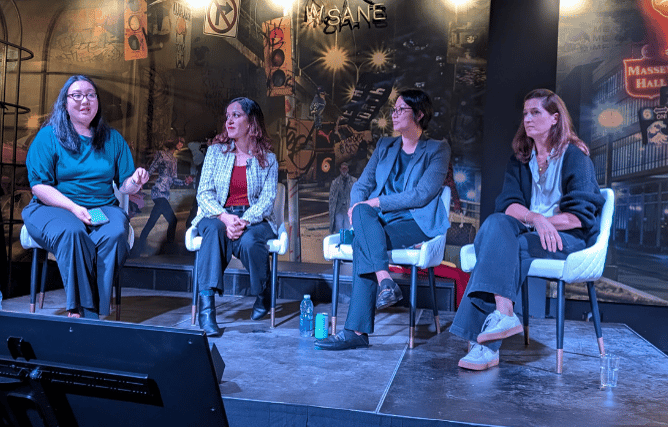
Hiring budgets are tighter, but employees are asking for more. That tension framed a panel at HRFest Canada in Toronto on Nov. 10, where the moderator put a blunt question to the speakers: what can employers really promise?
For Margot Perlmutter, chief people officer at Cannex Financial, the answer starts with not overselling.
"If you are going to bring somebody in with all these false pretenses, there's going to be a disconnect," she says. "You're not going to deliver on what you promised. They're going to leave."
Perlmutter was joined by Sania Sanzgiri, HR director at Toronto-based Neo Performance Materials, and Asumi Ishibashi, managing director of employee experience, AI workforce transformation and M&A at WTW. Across the session, three themes kept coming up: flexibility, autonomy and transparency.
Upfront about pay and promotions
Perlmutter says she was Cannex's first HR hire, about two-and-a-half years ago, in a company that has been around for roughly 40 years. She has focused on two areas: the compensation and benefits philosophy, and the growth path.
On pay, Cannex tells candidates upfront that it pays at about the 50th percentile.
"It's not that glamorous," she says. "It doesn't sound very appealing to a candidate at first,” says Perlmutter, but, in return, the company aims to offer above-average benefits, tracked through pulse checks and benchmarks.
In addition, 87 per cent of employees reported good work-life balance in Cannex's last engagement survey.
Career growth gets the same candour. "Because we're a very flat and lean organization, we are very transparent that if you want to climb that corporate ladder, Cannex is not for you," she says. "There really is no ladder… but, in exchange, you're going to have amazing access to the C-suite."
She says that pitch recently landed Cannex its first technical product manager, who came from seven years at a large corporation.
"He was tired of the red tape. He was tired of all the layers. He wanted to effect change. He wanted to get his hands dirty," says Perlmutter.
"If you want the title and the jump and the succession and the corporate ladder, we don't have the rungs, so we're not probably the right fit for you."
Drop the generic pitch
Ishibashi suggests a simple test. Go to your careers website, hide the logo and read the employee value proposition (EVP). Can you tell what kind of company it is, what it stands for or even what industry it's in?
Sometimes, it feels a bit generic, making promises about an amazing career or great rewards, she says.
"All of that could be true, but as an employee or candidate, I think I'm really looking to look [at] ‘What does that really mean for me?’"
With AI reshaping work, a career is no longer something an employer can guarantee, Ishibashi says.
"Maybe it's that we provide the right condition and the right access to the different opportunities, but we expect in return for you to really take ownership or participate, and it's a two-way."
The same applies to total rewards, with preferences varying by age group. Instead, she says employers can commit to learning what each employee values most and offering options, with a cost attached to each. "It's not about all of the bells and whistles," says Ishibashi.
Basically, with the EVP, “be really clear about what's expected in return and what's provided,” she says.
Flexibility first for employees
At Neo Performance, which operates in more than 10 locations, Sanzgiri says flexible schedules are what employees value most. That includes the freedom to plan their own day.
"In today's world, when companies are calling employees back, employees are at different life stages," she says. "They have stuff to take care of, personal life, dropping kids to school, picking them up, taking parents for appointments."
Neo has no office mandate, though it prefers to see people in person and uses lunch-and-learns to draw them in. "We get together so that that connectedness remains and we're not just working in silos in our own home office and not really knowing who is doing what," says Sanzgiri.
The company also has no formal sick-day or wellness-day concept, she says.
"If you're not feeling up to it, take time off, recover, and come back. I think that has gone a long way where people feel that they are trusted by the company and, hence, they give it back much more."
Because Neo is global, some staff take calls late at night or early in the morning, and managers take that into account, she says. Autonomy does not mean a lighter load.
"That doesn't mean that we are low on expectations," Sanzgiri says. "The expectations are there and everyone knows what to do."
A question in Neo's engagement survey on whether employees can decide how they do their work scored 4.5 out of 5, she says. "It doesn't matter where you are sitting, but what you're delivering is important.”
Perlmutter heard the same message when she joined Cannex, a fintech of about 40 people in the retirement and annuity space. She says she held one-on-ones with every employee, and about 90 per cent named the same thing they valued most: the choice to work from home or the office.
"We don't really say we're remote. We don't say that we're hybrid. I sort of classify it as employee's choice," she says. "Some people go in every week, some people go in once a month, some people never go in."
Rewards for every life stage
During the Q&A, an audience member asked whether the panellists had designed rewards for a multigenerational workforce.
Ishibashi says the answer depends on an employer's philosophy, but some design principles hold.
On benefits, some things must be guaranteed, she says, but beyond that employees can choose how to spend flex credits, whether on wellness or on something their dependants can use. WTW also looks at rewards as a portfolio.
"It's like allowing employees to do a trade-off decision," says Ishibashi. "I'll take more of this, less of this, and being able to package it is another way that we have done it."
Perlmutter says Cannex is roughly divided in half between employees aged about 50 and older and a younger generation coming in. About six months ago she surveyed staff on which benefits mattered to them, to show the executive team how the workforce was changing.
She says 40 per cent want parental leave, which Cannex does not currently top up, while another 40 per cent want support with elder care. The CEO, given the company's focus on retirement, has long prioritized retirement savings.
Cannex is now looking at where it can cut costs elsewhere to fund changes, says Perlmutter. "We haven't tackled it yet, but we're starting the conversation."
Neo took a similar route. Sanzgiri says it assessed its benefits last year using a utilization report, asked employees to weigh different packages, then redistributed its benefits based on the results. "People were happy about it because they knew that it was coming from their feedback," she says.