At HRFest Canada, Interac's CPO said phishing failures can hit pay, while experts from Deloitte, Fiera Capital and Fasken cite cybersecurity challenges of AI agents, deepfakes and insiders
At Interac Corp., clicking on the wrong link one too many times can cost employees part of their bonus.
"One click that's bad, it’s a test, you go back to training. Second click that's bad, you go back to further training. Third click that's bad, it actually affects your bonus," said Sudha Dwivedi, chief people and culture officer at Interac.
"So, people pay really strong attention to what they're going to click on."
That kind of approach makes sense given the stakes, said the HR leader, speaking at a session at HRFest Canada last week.
"Because our system is so connected with every single financial institution in Canada, someone clicks poorly and a bad actor gets in, the entire country shuts down,” she said.
The progressive phishing tests sit alongside compliance training and tabletop exercises, and they apply to everyone.
"It doesn't matter what level you are in the organization — from CEO to first-level individual contributor — everyone is treated the same way," said Dwivedi.
She said the goal is not to catch people out. Interac's foundation is trust and transparency.
"It's not about policing, right? We don't want people to feel like they're policed," she said. "It's not about trying to trap people, it's about ‘This is how important it is to us as an organization because Canadians are counting on us.’"
For Dwivedi, that is why cyber belongs with HR as much as IT.
"Everything we do is through people… regardless of what industry you're in," she said. "And yes, I know agents can do stuff, but someone's got to tell them what to do."
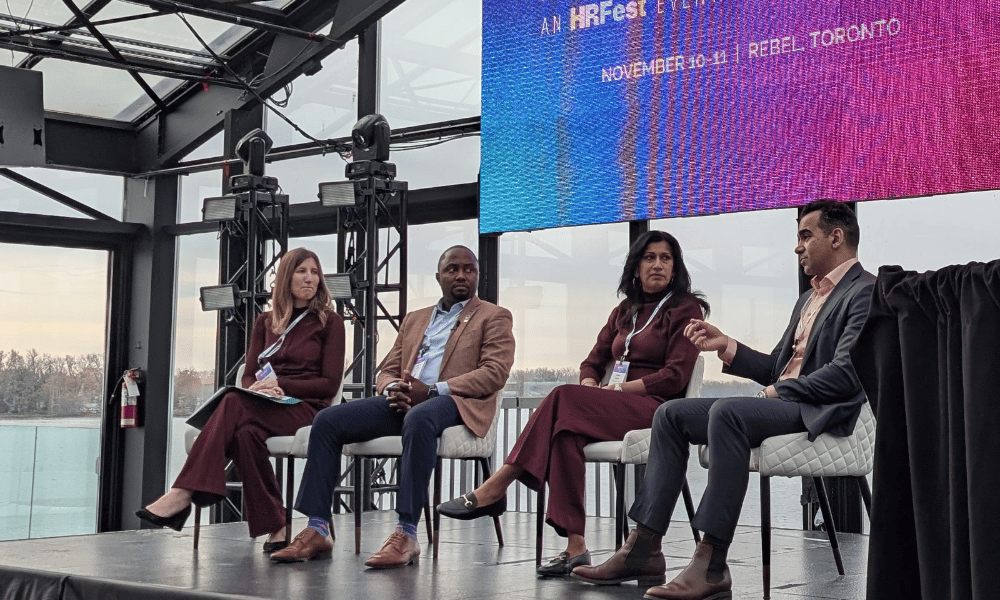
The Nov. 11 panel was moderated by Eowynne Noble, chief people officer at Fasken, who was joined by Ali Varshovi, partner and financial services cyber lead at Deloitte Canada, and Christian Kengne, senior director of cybersecurity technology at Fiera Capital.
Where HR's role begins and ends
Dwivedi said she works closely with Interac's chief of financial crime and its CISO, because whatever controls they design, people must carry them out. HR's job covers how the company hires, onboards and trains.
"Our role is to make sure that we make it easy and transparent for the employee base to understand what the responsibilities are," she said. "Then we hand it off to our tech partners to put those controls in place and the governance in place for that."
Dwivedi said the lesson runs both ways. Just as HR gets pushback when it launches programs at the wrong time, security teams need to involve HR early.
"Are you bringing your HR partner in early enough?" she asks. "We need to be brought in early so we can make sure that it works for the workforce."
Looping in HR for layoffs
Kengne said HR often holds context that security teams lack. He describes a common scenario: a senior executive is about to leave under an agreement with legal and HR, but no one tells the cybersecurity team.
"Then suddenly at 11 p.m., we start noticing that that user, that employee, is sending emails to a personal account, forwarding stuff," he said, and may also be opening data they haven't touched in 90 days.
Once HR is looped in, Kengne said, the picture changes: the employee is resigning in two weeks and has just signed an agreement. "HR was really key in bringing in the context to allow the cybersecurity team to do the job."
Layoffs raise the same issue. A company announces at a town hall that it is cutting 10 per cent of its workforce, he said, and suddenly people start to download things, leaving no time to put controls in place.
"What's really important is that you need to establish that relationship before the incident happens," said Kengne.
Get HR into tabletop exercise
Noble said Fasken has recently run tabletop exercises and crisis simulations, “because when you're in a crisis situation, it's very hard to react in the time that you need to react unless you establish clear roles and responsibilities."
In those plans, HR owns the employee investigation, training and communications, she said, in suggesting building cyber into HR's own planning, such as deciding at what point to bring in the CISO before a layoff.
Kengne asked the audience how many had taken part in a tabletop exercise that included HR. Few hands went up.
"It's not common, right?" he said. "Because generally people will do a little bit of exercise between the cyber executive team and legal, and that's it."
From his time in consulting at Accenture, Kengne said most insider risk investigations needed HR input, since patterns in an employee's behaviour before an incident can point to what drove it. "You need HR context, definitely," he said.
A workforce that isn't all human
One of the challenges is that HR's practices were built for a different era, said Varshovi.
"The way we manage and govern the workforce, all the practices, frameworks, we all built them and designed them for a workforce where the predominance of the force was humans working together in the offices, scoped and predictable," he said.
"I don't think that workforce exists anymore."
Work left the office during the pandemic and won't fully return, he said, and now, “a part of that workforce isn't even human,” Varshovi said, with software "that reads your email, summarizes the text, executes transactions, maybe autonomously on its own [and] has started to take actions."
Deciding how to onboard workers, who has access to what, how they are supervised and how they are offboarded has never been a technology call, he said: "These are workforce decisions."
From Varshovi’s perspective, a CHRO has always been a chief workforce officer, he said.
"It's just that now part of that workforce is an entity that doesn't come to a conference, doesn't attend a town hall, doesn't follow any HR policies, but he acts on behalf of your employees,” he said.
"The workforce is evolving much faster than any function designed to govern. So, ‘How do we keep up?’ is the main question for us."
Culture, security, surveillance
Noble said she often thinks about how to create a security-conscious culture, “but not a culture built on surveillance or mistrust," since that kind of culture stifles innovation and performance.
Varshovi said culture is exactly why cyber is an HR issue.
"Your CIO and CISO, the best they can do is to write a policy and put the regs in place. But this is culture change," he said. "The fact that people would follow or not follow a policy, that's all culture. It belongs in HR."
However, Noble stated that HR doesn't own culture, “everyone owns culture.” What matters is that people leaders know how to manage in the age of AI, she said, so Fasken has begun training on how to supervise in that environment.
"A lot of us are turning on Copilot, Copilot agents, Claude Cowork," she said. "Yet, people leaders are still struggling to understand ‘How do you supervise in this era?’
Kengne said leaders also must follow the rules they set. Employees can feel a sense of unfairness if, for example, leaders are exempted from completing the training, he said.
Giving some teams access to tools such as Copilot while blocking others invites workarounds, he said. "[People] don't bypass control just because they want to bypass. They will bypass control because they want their job to be done."
Noble agreed that the answer is not to lock everything down, "because then you're going to lose the benefits of the technology, the innovation, and the efficiency."
The real insider risk
Asked whether HR should focus on malicious employees stealing data, Varshovi said no. Focusing too heavily on malicious insiders, he said, "is very actively misleading," because it tunes controls to rare cases while everyday risk walks through.
He gives the example of an employee who gets a call from someone who looks and sounds exactly like the CFO, with an urgent but plausible request, and wires the money. On paper, that is an insider event. "But it's not really a malicious insider by any stretch,” he said.
Most risk, Varshovi said, comes from well-intentioned employees: someone pasting a sensitive customer list into ChatGPT to summarize it faster, colleagues sharing credentials to meet a deadline, or tech-savvy analysts giving AI agents broad permissions because the approval process takes three weeks.
"Have we designed the workforce in a way that doing the right thing and the secure thing is also the easy thing?" he asks.
Dwivedi said education is the answer, because "it's not a matter of ‘if’ we are going to get hit in your organization, it's a matter of ‘when’."
Psychological safety and cyber security
Kengne points to the 2019 Desjardins data breach as an example of an insider case. He said negligent employees account for most of those incidents. "If we build our insider threat program around the malicious ones, we are losing our vision on the big portion of it," he said.
That makes psychological safety essential, said Kengne. Employees need to feel they can quickly report clicking a bad link, giving away a credential or handing a task to an AI agent that went wrong.
"You need to create that psychological safety so that your colleague is able to do that."
Noble said delays in reporting are a real problem.
"Cyber can act quickly if they know something, but often what happens and what we know from the numbers is there's a bit of time between the incident and the report of the incident because the individual is so scared."
As deepfakes get more convincing, she said, "it's the sophistication of the deepfakes that are actually causing the issue, not necessarily the employee themselves."
No exemptions at the top
When the person creating the risk is a senior leader, Dwivedi said the rules still apply, and the bar is higher.
"The policy is policy. The progressive discipline is progressive discipline. However, if you're that senior, it's not a one, two, three warning, right?" she said. "With great power comes great responsibility, as Spider-Man said."
"The main point of that is that no one is exempt. Everything applies to everybody."
Kengne adds that exemptions can carry a financial cost. He cites a breach at the City of Atlanta in which the insurer refused to pay because the city had attested to having multi-factor authentication (MFA) everywhere when it did not, he said.
"If you do an exemption for a senior executive, don't forget that you're opening a door and maybe your cyber insurance will come after you," he said.
"People are watching," said Noble. "If you're not acting consistently, then people will start to think it's not something that's important to the organization."
'Are we protected?' is the wrong question
Noble asked whether boards are asking the right question when they ask, "Are we protected?"
"I have a lot of issues with that question," said Varshovi. "First, it's binary. It invites a yes or no answer, and nobody is ever protected. You're always managing."
"It's not really asking for information. It's asking for reassurance."
Instead, employers should ask what risk they are accepting when they onboard and offboard people, and, after any incident, ask what the company knew but never acted on, he said: "It's not an information issue. It's not a tool issue. It's a governance issue."
Varshovi said almost no organization "can tell with confidence who or what did something in your systems and for what reason," and boards should lead with that gap.
Kengne, who said he sits on a board in Quebec, asks a different question: "What are the follow-up actions of your last tabletop exercise?" Boards don't usually take part in those exercises, he said, but "if there's no follow-up, that means people are becoming comfortable."
The panel closed with a warning about offboarding. Employees used to leave with a badge and a laptop, maybe a credit card. Now, they create autonomous agents that keep running after they're gone.
"When they walk out, they're not going to shut down on their own. They'll continue to work," said Varshovi. "An extension of them will exist in the organization."