'Employers have to wake up if they want to be a best practice employer,' says disability expert discussing growing complexity of LTD claims

Chronic health conditions are shaping the modern workplace – and the stakes are growing, according to a new report.
More than half of Canadian workers are experiencing chronic health issues, with musculoskeletal, mental health, and cardiovascular conditions topping the list, accounting for 68 percent of long-term disability (LTD) claims, finds Sun Life
Bill Dyer, director of poverty reduction for the National Institute of Disability Management and Research (NIDMAR), isn’t surprised – according to him, many organizations are not internally equipped to handle complex disability cases.
“They have a very robust internal group that really focuses on occupational health and safety and return to work,” he says.
“On the non-occupational side of things, many organizations have little to no focus other than they might have an external insurance provider in place. And what they'll do for the most part is they'll advocate the responsibility to the external provider and leave it with them. There's no mandate, there's no process, there's no urgency internally.”
Time equals complexity in LTD claims
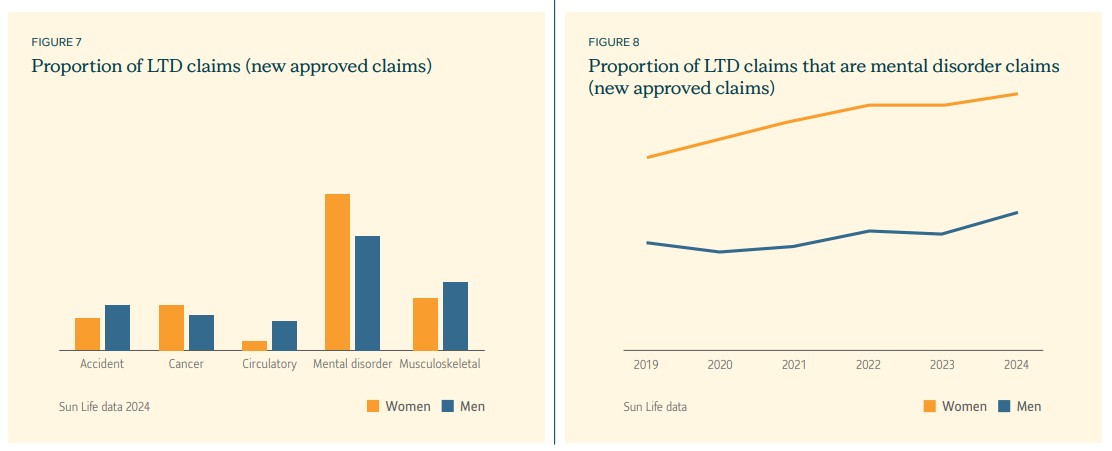
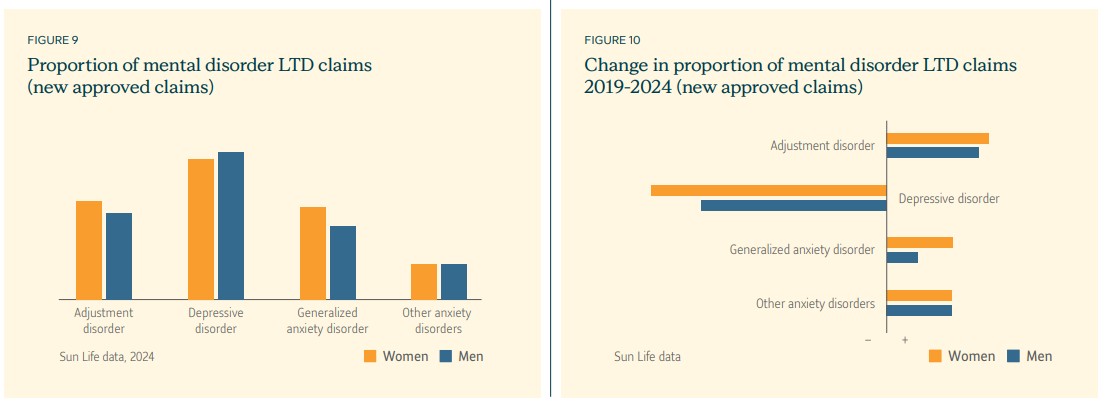
According to Sun Life’s data, mental health claims are the most common, with LTD claims involving mental health steadily on the rise, reaching 40 per cent of all claims in 2024.
For Dyer, this ties in with the lack of internal urgency around LTD claims: the longer an employee is on LTD, the higher the likelihood their case will grow in complexity as they get farther from their working life – even if the injury is simple to start.
“Duration is the silent killer,” he says.
“The longer someone's on claim, the longer they're away from the workplace, it becomes significantly more difficult to assist that individual in overcoming the barriers to return ... It could be initially their low back, their shoulder, their knee, their ankle. They fall away from the workplace, and due to the lack of proactivity, the lack of re-engagement back to the workplace, they start to drift.”
As time goes on for these employees, their reduced income leads to another factor that complicates cases: stress. Sun Life’s research supports this: mental health claims are both the most frequent and the most prolonged, often involving secondary conditions that further reduce the odds of successful return.
“When stress enters the picture, then they develop that secondary ailment or illness known as mental health,” Dyer says.
“Consequently, it becomes much more complex, much more delayed, much more impacting, and much more difficult for that individual to return back into the workplace in a positive, meaningful, respectful manner.”
Source: Sun Life
Diagnosis challenges and importance of communication
As employment and disability lawyer Tim Louis of Tim Louis and Company in Vancouver, explains, disability claims related to chronic conditions are often complex because diagnosis is not always straightforward.
This could lead to employers relying more heavily on both the employee’s word and “lateral” witnesses – a roommate, a partner, a former colleague, for example.
“In other words, getting outside of the four corners of the doctor's office,” he says, in the event a doctor for whatever reason is unable “to really get a fulsome handle on the insurance condition and whether or not and to what extent it is disabling.”
However, Louis stresses that in the current legal landscape with disability claims becoming complex, employers should be taking employee claims at face value, at least at the outset.
“The starting point should be that the employee is reliable and that what they're saying is truthful. There should be a presumption that the employee is being honest,” he says.
“Employees are your greatest asset. The disabled employee more often than not wants to keep working. Get their input and advice… ‘How might we work together collaboratively to make it possible for you to continue being an asset to our firm?’”
Supervisor connection with long-term disability
An oft-neglected but crucial part of the return-to-work process is the role of the supervisor. As Dyer explains, it should be the responsibility of the direct reports of employees on leave to keep them involved in the workplace. And this is where many organizations fall short, he says.
“The supervisor is the most important cog in the wheel of anyone that has an illness, injury or disability, whether that be workplace or non-occupational in nature,” Dyer says.
“In many organizations ... the supervisor does not communicate with that worker ever again until they return back to work.”
When supervisors communicate regularly with employees on leave – not just about their own case but to update them on organizational news and happenings – the impact can be significant. Dyer puts it plainly: “The cases where the supervisor stays in contact, there's better outcomes. The cases where the supervisor does not retain communication and contact with their worker, there's worse outcomes.”
Source: Sun Life
Holding insurers accountable in proactive process
Sun Life’s research notes that employer engagement and oversight, especially early in the claim process, can improve outcomes and reduce duration. Dyer agrees, and reminds employers of the consequences of not being proactive around employee disability claims.
“The people that suffer the most are the employer and the individual,” Dyer says.
“The employer has got that knowledge, that integrity that walks out the door in the way of their employee, and the worker loses their income, which impacts them, their family and everyone else in the picture. At the end of the day, the insurance carrier’s got nothing to lose. They're paid their premium.”
His recommendation for Canadian employers is to be more proactive in keeping third-party insurers accountable.
“Have an internal process protocol that mirrors that external insurance carrier’s disability process, so... and I hate to say it this way, they need to hold the insurance carrier's feet to the fire,” says Dyer.
“They need to ensure that they're living up to their end of the bargain. There needs to be a pretty good contract in place with regard to deliverables and outcomes and expectations, because at the end of the day, the people that suffer the most are the individual and the employer.”
Accommodation and retention in complex LTD claims
For HR professionals, accommodation is not just a compliance issue, it’s a retention strategy, says Louis. For him, the advice is simple: “Accommodate, accommodate, accommodate.”
With technology and the ever-changing workplace environment, it is no longer a prohibitive or complicated process to accommodate employee needs, he says. And the motivation should be real, as the cost for not doing so will likely outweigh any benefit.
“I would urge the employer to take into consideration the cost of a claim [versus] interviewing for a new employee, training the new employee, the possibility that the new employee will not be a fit, other hidden costs,” Louis says.
“If you're not making a reasonable accommodation, then you are exposed to a human rights complaint. The Human Rights Commission can – or I would say should – levy hefty fines.”
Flex hours, reduced or part-time hours, working from home, and reshaping roles are all ways that employers and HR can work with employees who are making claims or experiencing barriers, Louis says: ‘It is becoming easier and easier for a creative employer to accommodate.”
Pointing out that younger workers are not averse to quitting if they do not feel supported by their employer, Dyer adds that accommodating employees with mental health issues and other complex needs is also an issue of retention.
“Employers have to wake up if they want to be a best practice employer, if they want to be one of those top employers in Canada that people want to work for,” he says.
"They’re going to have to kind of think outside the box a little bit with regards to ‘We want to look after our employment group.’ ... Best practices in disability management do not discern whether it be an occupational injury or a non-occupational injury, they treat everything the same.”