StatCan report shows top reasons why mothers go back to their jobs after having a child

Employers can ensure that workers who are giving birth will eventually return to their jobs by ensuring the quality of jobs that they have in the first place, according to a recent report.
A permanent job, union coverage and higher wages are the strongest predictors of whether a mother returns to work after parental leave, far outweighing which Employment Insurance benefit plan she chooses, Statistics Canada notes.
"Mothers who had a higher-quality job—characterized as a permanent job, with union membership or collective agreement coverage and higher hourly wages—were more likely to return to work following parental leave," writes report author Youjin Choi, of Statistics Canada's Economic and Social Analysis and Modelling Division.
Mothers with permanent jobs were 11 percentage points more likely to return than those in temporary or seasonal roles, while union members or those covered by a collective agreement were 5 percentage points more likely to return, the data show. Mothers earning $15 to $19 an hour were 9 percentage points less likely to return than those earning $20 to $29, giving employers concrete levers for retention.
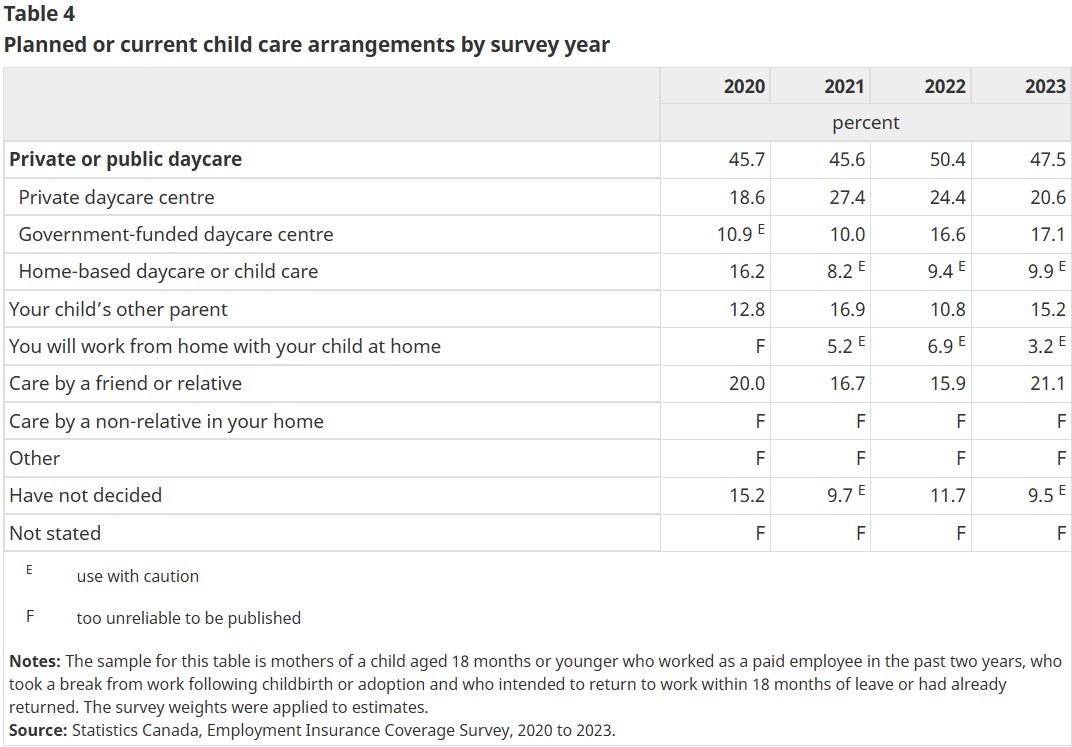
A previous report revealed how work-from-home (WFH) and other remote work options impact the “motherhood penalty” – the persistent and measurable disadvantage women experience in the workplace after having children.
Leave length shapes timing, not likelihood of return
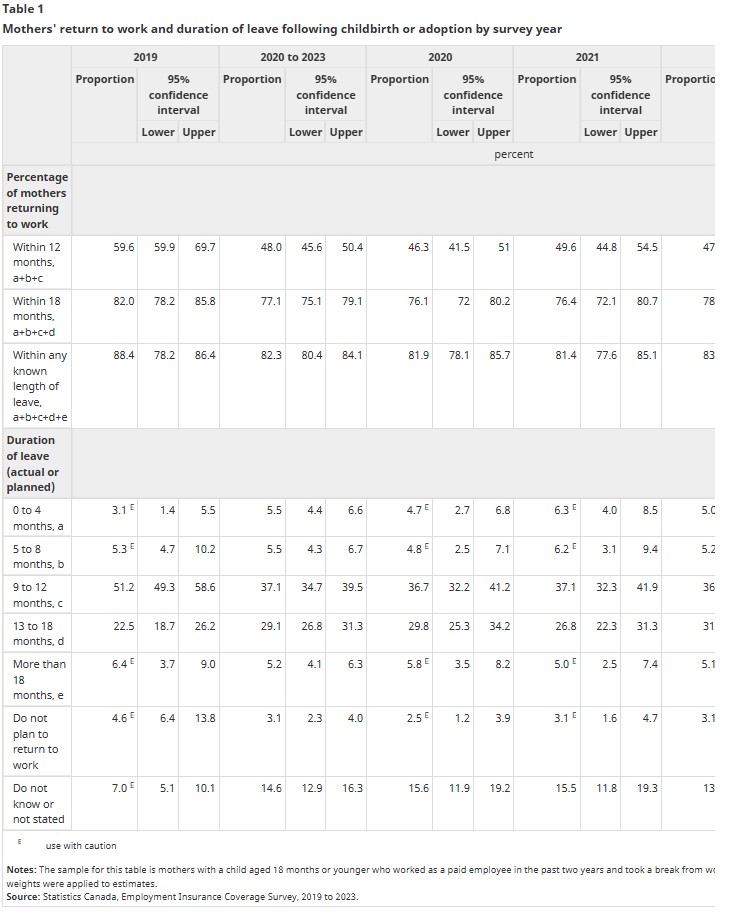
StatCan found that 82 per cent of mothers with a child aged 18 months or younger had returned or planned to return to work after any length of leave, with nearly identical overall rates between those choosing EI standard benefits (83 per cent) and EI extended benefits (82 per cent).
The gap emerged in timing rather than outcome: Mothers who chose extended benefits were 44 percentage points less likely to return to work within 12 months of leave than those who chose EI standard benefits, once other factors were controlled for, according to the report.
Just 14 per cent of extended-benefit recipients returned within 12 months, compared with 51 per cent of standard-benefit recipients.
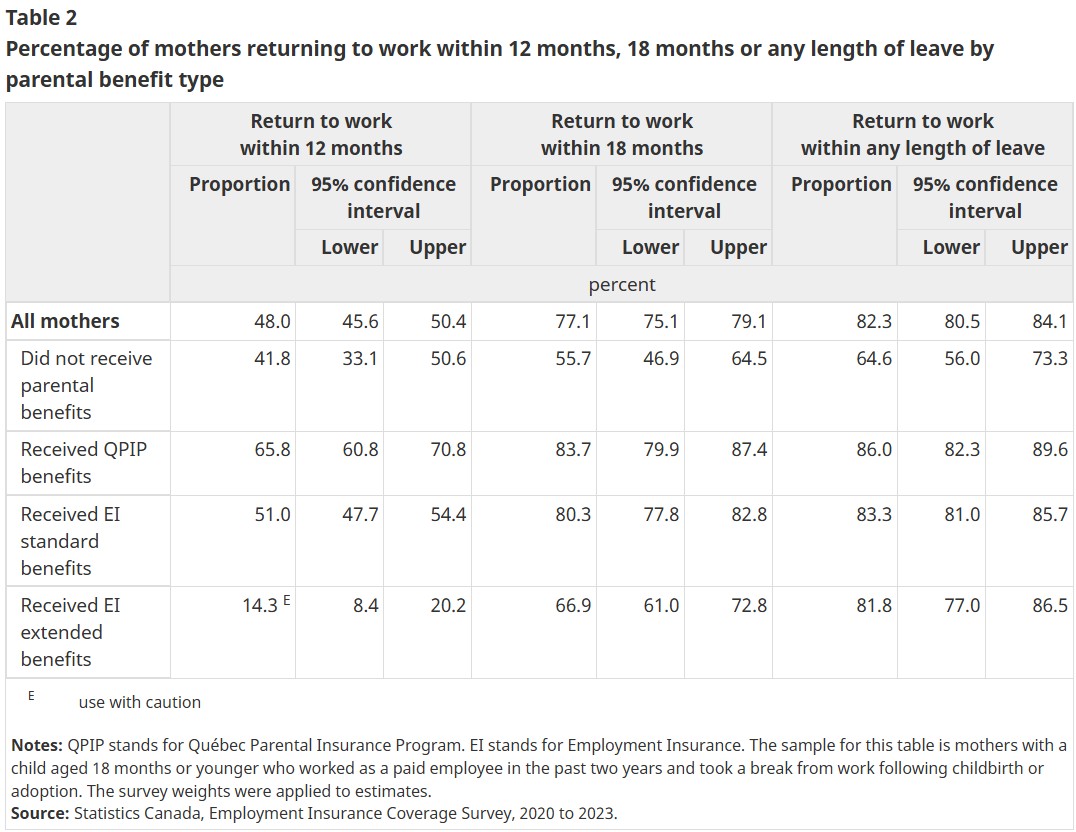
Mothers who received no parental benefits at all returned at lower overall rates than benefit recipients, at 65 per cent, "18 percentage points lower than the average rate for all mothers," and were more often younger, immigrants, or working temporary or part-time jobs without union coverage.
Non-returning mothers
One positive note for employers is that very few mothers are choosing not to return to work.
Overall, 3.1 per cent of mothers (2020 to 2023 combined) said they did not plan to return to work, following childbirth or adoption. Statistics Canada flags this figure as one to "use with caution" due to data reliability at that sample size.
By survey year, this breaks down as:
- 2020: 2.5 per cent
- 2021: 3.1 per cent
- 2022: 3.1 per cent
- 2023: 3.6 per cent
For comparison, in 2019- (before the target population expanded to include mothers with a child up to 18 months old - the figure was 4.6 per cent.
Postpartum depression has long been treated as a short-term clinical concern, but recent data from Denmark and Canadian parent-child health research showed it can quietly shape women’s employment, earnings and promotion prospects for years after birth — especially when workplaces are inflexible and support is thin.