Facing a pregnancy loss while keeping it hidden can compound the acute mental and emotional toll

There are some things that are just hard to talk about, especially at work. As human beings, however, people do not have the option of simply leaving their non-work lives at the door when the workday begins. This is especially true now, when for many of us, the commute to the office is a four-metre walk across the room.
When people experience personal trauma and loss, such as a miscarriage or stillbirth, they can’t compartmentalize it and go about business as usual. I have been fortunate; I have two sons and feel very lucky to have been working at organizations during my pregnancies where I knew I would have had the support to take miscarriage leave, had I needed it.
But for many people, this has not been the case. When they experienced such a loss, they didn’t always feel comfortable sharing it with their employer, and many were even worried that taking time off after a miscarriage would not have been acceptable to their workplace culture. Instead, they suffered in silence, privately grieving but still going through the motions of day-to-day working life.
It doesn’t have to be that way. Employers can and should offer better support to their employees. Xero, for instance, believes that everyone benefits when you create “a culture of psychological safety,” according to chief people officer Nicole Reid.
It’s about giving people a space in which their voices can be heard, their individual strengths can be celebrated, and their concerns can be supported. In short, it’s about putting the human element first.
Taking New Zealand’s lead
In March, New Zealand passed a law giving mothers and their partners three days of paid leave to grieve after experiencing a miscarriage or stillbirth. For Ginny Andersen, the Labour Party MP who initiated the bill, it was an opportunity for the government to step in and address a real need that some employers in the country were leaving unmet.
“We are fortunate enough to have many decent employers in this country who are already allowing bereavement leave to be taken in the event of miscarriage or stillbirth,” Andersen told New Zealand’s parliament. “But there are some who are not. There are some who are making employees use up their sick leave at a time when they are dealing with extreme loss. That is callous and that is wrong. The grief that comes with miscarriage is not a sickness. It is a loss, and that loss takes time — time to recover physically and time to recover mentally.”
Shortly thereafter, Xero — which has its headquarters in Wellington, N.Z. — decided to broaden its definition of bereavement leave to include instances where someone has suffered the end of a pregnancy as a result of miscarriage or stillbirth. This was something that the company had generally been doing already, but — inspired by the country’s new legislation — decided to formally enshrine as part of its updated parental and general leave policies.
A Canadian response
Here in Canada, federal policy states that if a woman’s pregnancy ends before week 20, she could receive sickness benefits, and that if her pregnancy ends in week 20 or later, she could receive maternity benefits. The amount of unpaid leave offered to those who suffer pregnancy loss due to miscarriage or stillbirth varies by province.
For example, in Ontario, an employee who has a miscarriage or stillbirth within the 17-week period preceding the due date is eligible for pregnancy leave. The latest date for commencing the leave in that case is the date of the miscarriage or stillbirth.
The pregnancy leave of an employee who has a miscarriage or stillbirth ends on the date that is either the later of 17 weeks after the leave began or 12 weeks after the stillbirth or miscarriage.
In Saskatchewan, an employee whose pregnancy terminates up to 13 weeks before the estimated date of birth due to a miscarriage or a stillbirth may take 19 weeks of maternity leave.
Paid leave is up to the employers’ discretion, which presents employers across the country with an opportunity to take a people-first approach and lead with compassion.
Xero has now extended this policy change to all Canadian employees or “Xeros,” as we like to call ourselves. As in Wellington, all Canadian Xeros are entitled to paid bereavement leave after a miscarriage or stillbirth. Up to three days is standard, but the company recognizes that everyone processes loss in their own way, and the amount of time an employee may need to take away from work will vary.
Starting a conversation
We also recognize that these are highly sensitive personal matters, so any decision about disclosing details around a miscarriage or stillbirth should be up to the individual. It’s important that employees are able to access the support they need while maintaining their privacy. For many, the assurance of confidentiality is key to them feeling comfortable enough to ask for help.
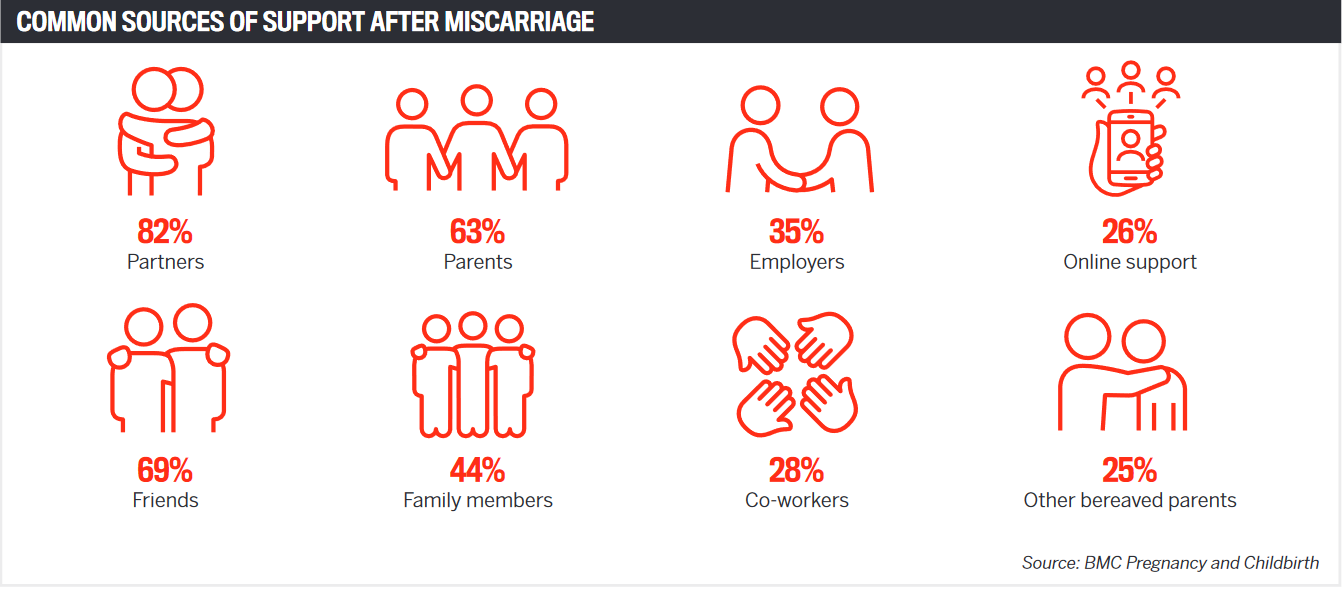
At the same time, workers should never be made to feel as if they need to keep their pain to themselves. Far too often, hopeful parents-to-be feel compelled to keep their family ambitions a closely guarded secret, especially in the workplace. Whether they’re trying to conceive, struggling with infertility or dealing with a miscarriage, their default is to hide these events from employers and colleagues.
Facing a pregnancy loss while trying to keep it hidden can compound the already acute mental and emotional toll.
There is a power that comes from people explicitly naming their experiences in order to de-stigmatize them and start a much-needed conversation.
Miscarriage is, sadly, a common occurrence. It’s estimated that anywhere from one in four to one in six pregnancies are affected. When employers create a workplace culture that normalizes the experience — while acknowledging that it is a deeply traumatic one — team members are empowered to decide how (or even if) they would like their employer to support them.
Putting people first
Opening up this line of communication also helps to create the aforementioned culture of psychological safety, one in which employees feel heard, understood and supported. Organizations have a responsibility to their workers; when they formalize that responsibility by writing it into policies that centre the human element, they can shift the power dynamic in a crucial way — moving the onus from the employee and placing it squarely on the organization.
Xero recognizes that any organization’s most sustainable source of competitive advantage is its people. When an employer puts people first — by prioritizing the mental and physical wellbeing of workers — it creates an environment in which employees can bring their best selves to the table.
And that, as it turns out, is a great way to boost productivity.
The bottom line is that offering paid bereavement leave is a policy rooted in compassion — and leading with compassion is always good for business.
 Faye Pang is Canada country manager at Xero in Toronto, a cloud-based company specializing in accounting software. For more information, visit www.xero.com/ca.