‘Workers without access to formalized training are the ones most at risk of falling behind’

Most workers say artificial intelligence (AI) has made their jobs more enjoyable, but the gains are landing mainly with senior leaders while entry-level staff get less training, according to a new survey with lessons for Canadian HR teams.
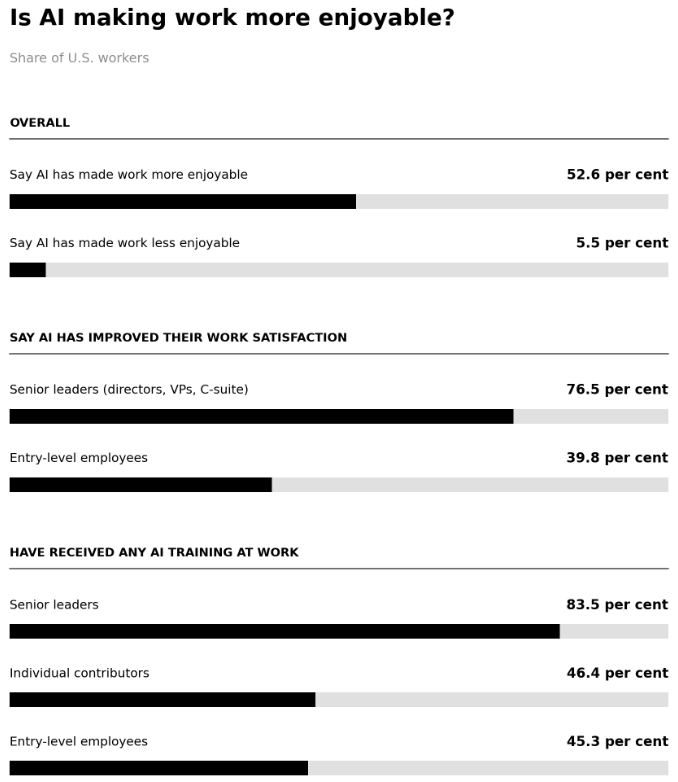
Santa Monica, Calif.-based online job marketplace ZipRecruiter Inc. released its 2026 AI Worker Report on Oct. 26, 2026, finding 52.6 per cent of workers say AI has made work more enjoyable and 5.5 per cent say the opposite. The survey polled 1,500-plus U.S. workers, not Canadians.
The divide follows seniority. Some 76.5 per cent of senior leaders say AI has improved their work satisfaction, compared with 39.8 per cent of entry-level employees – a split that mirrors training, which 83.5 per cent of senior leaders have received versus 45.3 per cent of entry-level workers.
Canadian data show a similar tilt. In March 2026, generative AI use was highest in legislative and senior management occupations (75.1 per cent), according to Statistics Canada.
"As the end of 2026 approaches, AI is becoming unavoidable in the workplace. But for many workers, that's looking like a net positive change. As AI automates more friction, workers find that they can focus on the aspects of work they actually like. But the training necessary to learn how to use new technology isn't making its way to the bulk of the workforce, leading to a self-teaching burden placed on workers themselves. As expectations rise, the workers without access to formalized training are the ones most at risk of falling behind," said Nicole Bachaud, labour economist at ZipRecruiter.
Does a more enjoyable job mean better business performance?
Output gains are harder to prove. Weekly generative AI use among employed U.S. adults rose from 28.2 per cent in the third quarter of 2024 to 39.2 per cent in the second quarter of 2026, according to a Federal Reserve Bank of St. Louis tracker.
A February 2026 working paper by Donghyun Suh and Samil Oh found AI cut Korean workers' hours by 3.8 per cent, with near-zero link to output, as workers took the gains as on-the-job leisure. It is not peer reviewed.
Management may convert saved time into results. U.S. employees whose managers actively support AI use reported 48 per cent engagement, versus 30 per cent without that support, according to Gallup's midyear 2026 data.
Rising productivity expectations and faster skill decay
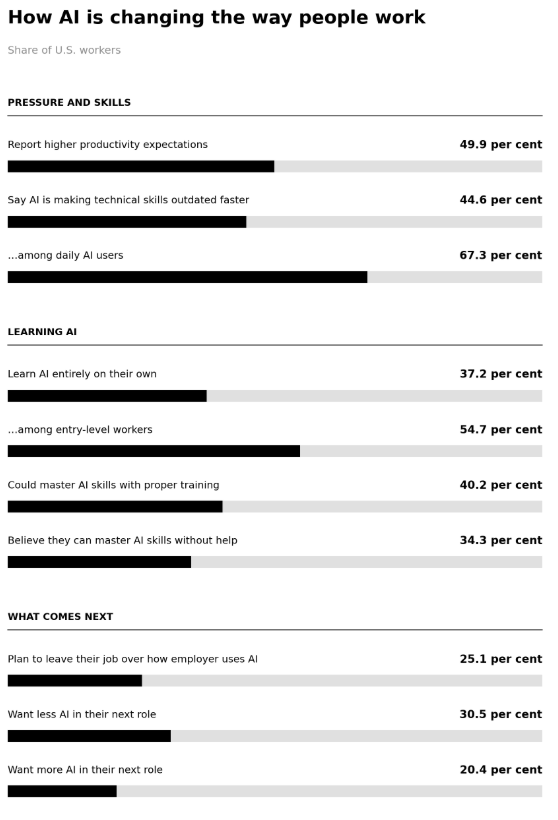
Employers are already banking on those gains. Half of workers (49.9 per cent) report higher productivity expectations, 44.6 per cent say AI is making their technical skills outdated faster, and 37.2 per cent are teaching themselves, ZipRecruiter found.
Canadians report similar strain. Employment Hero found nearly half of Canadian workers feel guilty using AI at work, while the 2026 TD AI Insights Report found nearly one in three Canadians admit to exaggerating their AI skills at work and only 37 per cent received adequate employer training.
"The future of work will require organizations to help people develop new skills as technology evolves," said Melanie Burns, senior executive vice-president and chief human resources officer at Toronto-based TD Bank, in a July 2026 release. "Those that prioritize learning and equip employees with the right tools and support will ensure their people thrive."
AI could drive the next wave of turnover
Weak support carries a retention cost. A quarter of workers (25.1 per cent) plan to leave their job over how their employer views or uses AI, and 30.5 per cent want less AI in their next role, ZipRecruiter found.
Canadian employers sense the unease. An Express Employment Professionals-Harris Poll survey showed AI may boost productivity but it is also causing anxiety among Canadians, with 66 per cent of hiring managers believing staff fear generative AI will make them useless.
In Ontario, openness is now law. Since Jan. 1, 2026, the Employment Standards Act, 2000 has required employers with 25 or more employees to state in public job postings whether they use AI to screen, assess or select applicants.
The ZipRecruiter data point to a fix: only 34.3 per cent of workers believe they can master AI skills alone, while another 40.2 per cent say they could with proper training.