Which occupations and age groups are seeing the lowest engagement?

Engagement and retention risks may be building for Canadian organizations as job satisfaction among Canadian workers has stalled below 2023 levels, according to a report.
The weakest scores are concentrated among younger and lower-paid staff, according to new data from Statistics Canada (StatCan) released on Nov. 6..
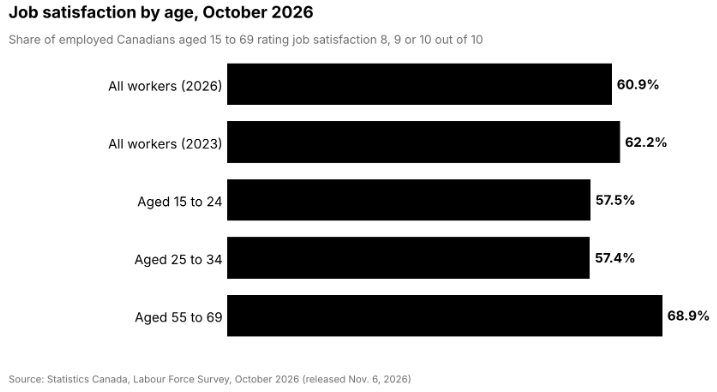
In its Labour Force Survey (LFS) for October 2026, StatCan found 60.9% of employed Canadians aged 15 to 69 rated their job satisfaction eight or higher out of 10, down from 62.2% in 2023.
The findings carry added weight as nearly one in four Canadian workers are looking to switch jobs this year.
“For anyone hoping that October would bring a recovery in the Canadian job market after back-to-back negative surprises, today’s release is a disappointment,” said Sneha Puri, an economist with Indeed Hiring Lab, in a media statement.
Job satisfaction is a quality of life measure
StatCan treats satisfaction as more than a workplace metric, noting it can reflect pay and benefits, working conditions, and how well a role fits a worker’s education, skills and experience.
Its earlier analysis of October 2023 data found employees in households facing financial difficulty rated their job satisfaction at 6.9 out of 10, compared with 8.1 for those who found it very easy to meet their needs.
That pressure is building again. StatCan reported 29.7% of Canadians lived in households struggling to meet basic financial needs in October 2026, up 2.0 percentage points in a year – a trend echoed in reporting on Canadian workers being more dissatisfied than ever.
Younger workers report lower satisfaction
Age is one of the clearest dividing lines. Just 57.5% of workers aged 15 to 24 and 57.4% of those aged 25 to 34 said they were very satisfied, according to StatCan.
Workers aged 55 to 69 were the most content, at 68.9%.
The gap of more than 11 percentage points comes as early-career workers face a tougher market, with youth unemployment rising 0.7 points to 13.7% in October 2026, StatCan said.
Pay gap tracks the occupational divide
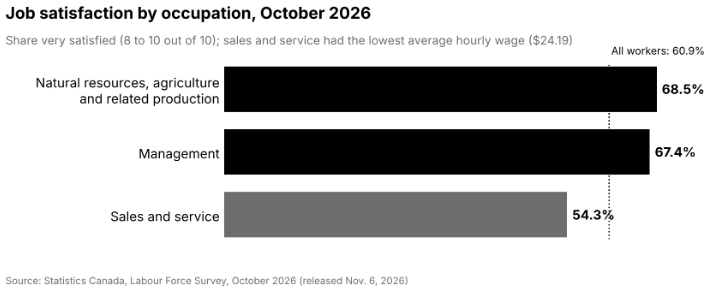
Occupation produced the widest spread. Workers in natural resources, agriculture and related production roles were most likely to be very satisfied, at 68.5%, followed by management occupations, at 67.4%.
Sales and service workers trailed at 54.3%, the lowest of any broad occupational group. StatCan noted this group also had the lowest average hourly wage, at $24.19.
StatCan did not attribute the gap to wages alone. ADP Canada’s Happiness@Work Index for May 2026 ranked work-life balance and flexibility as the top contributor to worker satisfaction, ahead of compensation and benefits.