What will first increase since July 2023 mean for HR strategies?
The Bank of Canada raised its benchmark interest rate on Oct. 28, 2026, lifting borrowing costs just as HR leaders finalize 2027 compensation budgets amid a weakening job market.
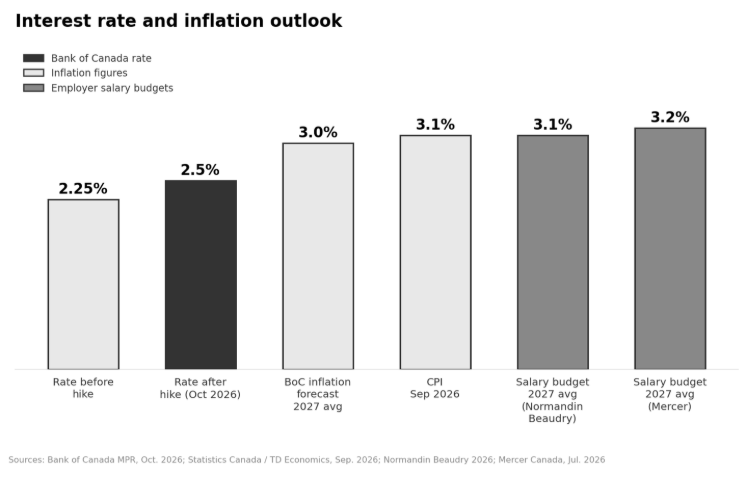
The central bank increased its target for the overnight rate by 25 basis points to 2.5 per cent, its first increase since July 2023 after seven consecutive holds at 2.25 per cent. Governing Council said it acted to reduce the risk that persistently high energy prices spread broadly to other goods and services, and signalled further increases could follow.
"With the outlook for inflation substantially higher and the economy showing resilience, an increase in the policy rate is needed to reduce the risk that elevated energy prices could spill over and become generalized inflation," Governor Tiff Macklem said in his opening statement.
Why the inflation outlook matters for compensation planning
The bank's October Monetary Policy Report (MPR) projects consumer price index (CPI) inflation will reach about 3.5 per cent by the end of 2026 and average 3 per cent in 2027 – one percentage point above its July forecast – before easing to 2 per cent by mid-2028.
Employers have budgeted similar amounts for pay. Normandin Beaudry's survey of more than 800 organizations puts average 2027 salary increases at 3.1 per cent, excluding freezes, as Canadian HR Reporter reported in its coverage of Canadian employers holding the line on salary increases for 2027. Mercer Canada's July 2026 survey put total increases at 3.2 per cent.
Set against the bank's forecast, those budgets point to little or no real wage growth in 2027. Pay is already trailing prices: average hourly wages rose 2.3 per cent year over year in September, according to TD Economics' analysis of Statistics Canada data, while CPI inflation reached 3.1 per cent, Statistics Canada reported.
Cost pass-through and a softening labour market
The bank said businesses have mostly absorbed higher input costs, but its surveys suggest pass-through will increase over the next year. "Most businesses continue to absorb all or part of these additional costs," Simon Gaudreault, chief economist and vice-president of research at the Canadian Federation of Independent Business (CFIB), told Money.ca before the decision.
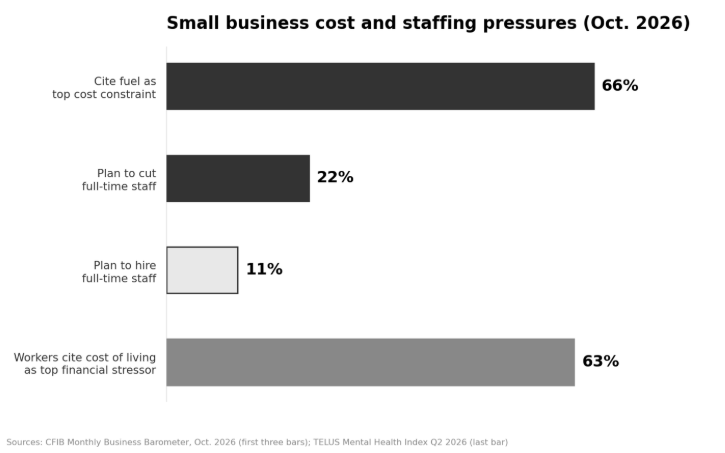
CFIB's October 2026 Business Barometer found long-term confidence edged up to a neutral 50.0 from 48.5 in September, with fuel the top cost constraint for 66 per cent of businesses. But staffing plans weakened: 22 per cent of employers expect to cut full-time staff, while 11 per cent plan to hire.
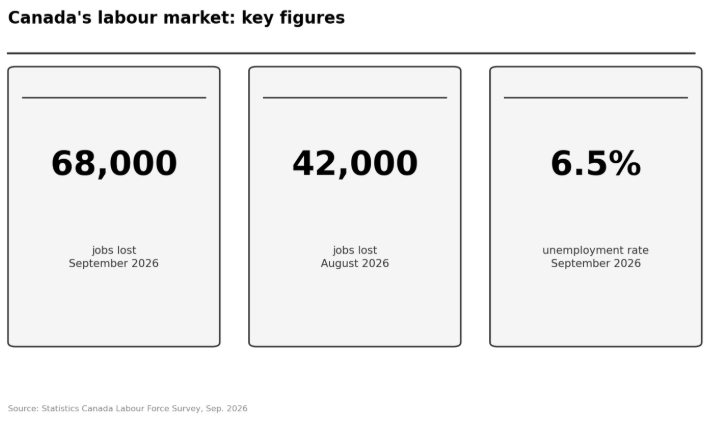
Statistics Canada reported the economy lost 68,000 jobs in September after shedding 42,000 in August, pushing unemployment to 6.5 per cent. Macklem said some excess supply remains, but projected growth of about 2 per cent in 2027 and 2028 "absorbs the remaining slack in the economy."
What the rate hike means for HR leaders
Before the announcement, Andrew DiCapua, principal economist at the Canadian Chamber of Commerce, told CBC News the economy was too weak for a hike. "The economy doesn't need that slowing. We don't need to hit on the brakes," he said.
Macklem acknowledged the case for waiting. "The main argument for holding was that the rise in inflation has so far been concentrated in energy prices and in services that rely heavily on energy inputs, such as airfares," he told reporters.
For HR leaders, higher mortgage and loan payments add pressure on already stretched workforces. The TELUS Mental Health Index for the second quarter of 2026 found 63 per cent of workers name the cost of living as their top financial stressor, as Canadian HR Reporter reported in its analysis of how financial stress is harming Canadian workers' productivity. Those pressures were already visible before the hike, as Canadian HR Reporter's earlier reporting on Canada's cautious approach to salary increases in 2027 showed. The bank's next decision is due Dec. 9, 2026.