From identifying hazards to investigating harassment, experts provide a breakdown of the obligations, the definitions, and what HR should be doing now

British Columbia employers could soon face new legal obligations to treat workplace mental health hazards as WorkSafeBC looks to introduce a comprehensive psychological health and safety framework into the province's Occupational Health and Safety Regulation.
The proposed amendments, currently in public consultation until Nov. 6, would add an entirely new Part 4.1 to the OHS Regulation — covering psychosocial hazards, harassment and violence under one consolidated framework. (Update: Due to the provincial election, WorkSafeBC says consultations have been paused until further notice.)
The changes respond to a steep and sustained rise in mental disorder and violence-related claims. According to WorkSafeBC, accepted psychological injury-only claims climbed from about 419 per year before 2015 to 912 in 2018, 1,717 in 2019, and 2,613 in 2025. Accepted claims related to violence increased 31% between 2020 and 2025, rising from 2,793 to 3,827. During that same period, workers filed about 6,905 bullying and harassment complaints.
And B.C. is unlikely to be the last province to move this way, according to one expert.
"We're going to see more of this type of regulatory change happening across the entire country," says Olga Morawczynski, co-founder of Heal-3, citing a 10-per-cent increase in psychological injury claims across the country.
“So, this is probably relevant for employers in B.C., but it's also relevant for employers everywhere else in Canada."
Psychosocial hazards in B.C.
On the psychological health and safety side, WorkSafeBC is determining a very clear process for employers to follow, she says.
“It’s taking a preventative approach to workplace mental health. And really understanding what hazards within the workplace might be causing psychological injury.”
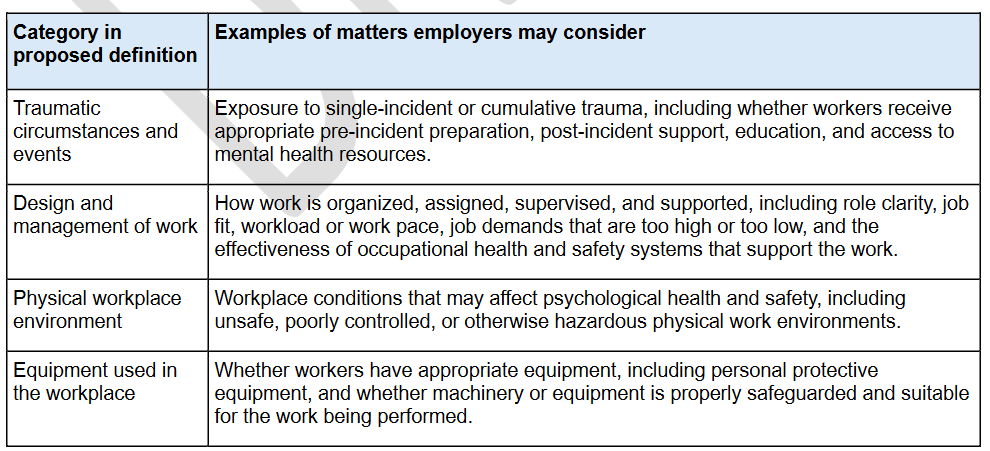
The proposed definition of "psychosocial hazard" identifies four broad categories of contributing factors:
- traumatic circumstances and events to which workers could be exposed
- the design and management of work
- the physical workplace environment
- equipment in the workplace.
Proposed section 4.108 would require employers to identify workplace hazards that could expose workers to the risk of psychological injury, prepare a written risk assessment, and then either eliminate those hazards or “minimize the risk of psychological injury from psychosocial hazards to the lowest level practicable by implementing control measures.”
Employers would be required to review their risk assessments at least annually, evaluate the effectiveness of controls, and modify those controls when significant changes occur in the workplace.
New ground for psychological safety
Kristen Shaw, an associate at McMillan in Vancouver, says the psychosocial hazard piece is genuinely new ground while the harassment and violence proposals are largely a consolidation and clarification of obligations that already exist across regulations and policy documents from WorkSafeBC.
"Where we're seeing a bigger change is that separate proposal to add requirements for employers to identify, assess and control psychosocial hazards," she says.
"Currently, there's the general requirement for employers to protect worker safety, which can include psychosocial hazards, but these new proposed amendments are quite an extension of what the specific requirements are that exist today."
WorkSafeBC is very clear about what needs to be assessed, says Morawczynski.
“[Employers] have to go and not only know what those things are but have a plan in place where they implement something called control. And a control is something that essentially takes that hazard and tries to decrease the risk or mitigate the risk or eliminate the risk.”
Proposed section 4.109 requires employers to ensure each worker receives ongoing education, training and information about psychosocial hazards relevant to their workplace and tasks. The appropriate frequency may vary by workplace, nature of work, and circumstances of employment.
Employers must consult with the workplace representative when developing or selecting training materials and keep records of all education and training provided.
Hazard identification
One of the most significant practical implications of the proposals is the requirement for employers to consult workers when identifying psychosocial hazards, and to consult with the workplace representative — whether that's a joint health and safety committee, a worker health and safety representative, or the workers themselves — throughout the risk assessment and control measure process.
Morawczynski says this isn't just a procedural requirement — it reflects how effective psychological health and safety programs actually work.
"This isn't something that HR can do all on their own," she says. "It's the first time we're seeing occupational health and safety now have to really work with HR, with operations, with workplace representatives… to identify and manage and control these hazards well, to implement the structure of psychological health and safety."
Shaw notes that the scale and complexity of consultation will vary significantly by employer.
"I expect it would be a fairly simple process for a small workplace with a single physical office," she says. "But it might be more complex for an employer with multiple remote and varied worksites. So, what that looks like will depend."
On the question of whether hazard identification could implicate management decisions like restructuring or increasing workload, Shaw is measured.
"Restructuring might be a stretch," she says. "I know that WorkSafeBC has talked about how work is assigned, supported — and workload might be considered a hazard. But these definitions as they stand right now are quite broad and quite general."
As of Oct. 6, 2025, Quebec requires employers to document their prevention efforts for psychosocial risks — factors that can erode mental health — such as excessive workload, lack of recognition or unclear roles.
Harassment and violence changes
On the harassment and violence side, the proposals would replace a patchwork of regulatory and policy requirements — sections 4.24 to 4.31 of the existing OHSR, plus bullying and harassment policy items in the Prevention Manual — with two unified frameworks that apply regardless of whether the person engaging in harassment or violence is a worker or an outsider.
Currently, the OHSR only addresses violence committed by non-workers; changing the definition to cover all sources would make BC unique in Canada, says WorkSafeBC.
The proposed harassment and violence frameworks each require employers to develop a formal prevention program, and the regulatory language is specific about what those programs must contain.
When the employer receives a report of harassment or becomes aware of a possible occurrence, proposed section 4.113 requires the employer to create a record of the occurrence, determine whether any workplace conditions or activities contributed to it, and, if necessary, implement or modify control measures “to eliminate or minimize the risk of recurrence.” Policies must be reviewed and evaluated at least annually, modified when necessary, and made readily available to workers.
The violence prevention program, required under proposed section 4.114, follows a similar structure around identifying hazards, with additional specificity around risk assessment. Employers must consider:
- the type, location, layout and conditions of the workplace
- the nature of the work and the interactions that occur
- any history of violence
- hazards common at similar workplaces
- circumstances outside the workplace that could give rise to violence — including actual or threatened domestic violence.
As part of the program, employers must make the most current risk assessment, a description of control measures, and their written violence policies readily available to workers at the workplace.
As with harassment, when an employer receives a report of a violence incident or becomes aware of one, proposed section 4.118 requires creating a record, determining contributing workplace conditions, and modifying control measures as needed.
New definitions for workplace safety
HR will want to take note of the proposed definitions. “Violence,” for example, covers not only the “application of physical force” but threatening statements or behaviour “that can reasonably be expected to give workers cause to believe” they are at risk of injury.
The violence doesn't actually have to happen, says Morawczynski.
"People just need to think that they're at risk of that,” she says. “What that means is even if there's threatening statements or behaviours that can make somebody reasonably feel that they're at risk, then the employer is essentially responsible for managing or mitigating those.”
The definition of "harassment" captures actions of a sexual nature and those targeting personal characteristics including race, religion, age, Indigenous identity, sexual orientation and gender identity or expression — covering conduct that is directed at a worker, occurs in the workplace or is work-related, and “can reasonably be expected to be intimidating, humiliating or otherwise offensive to the worker.”
The proposals also extend the reach of both definitions to work-related activities beyond the office or job site.
"The new definitions are seeking to clarify and confirm… that things like harassment or violence might not occur in the physical workspace — it could, for example, happen during an offsite company social event or during a work trip," says Shaw.
On the question of “good faith management actions,” she says the proposed carve-out — which states that actions “taken in good faith by an employer or supervisor in respect of the management of a workplace or worker do not constitute harassment” — is about clarifying an existing standard.
"It's more a question of ‘how’ and not ‘what,’" she says. "A supervisor could reasonably provide an employee with honest, constructive feedback about their work product in a private meeting or even in a helpful, honest and constructive way in a group meeting. But if a supervisor were to demean an employee publicly about their work product with the intention to belittle or embarrass that employee, that might be harassment."
One area Shaw flags is the potential for overlapping claims across different legal frameworks. Currently, there can be an overlap with bullying and harassment, as the same incident could trigger obligations under both WorkSafeBC and the Human Rights Code, if, for example, an employee is dismissed for filing a harassment complaint that involves discriminatory language.
A similar situation might arise with psychosocial hazards, says Shaw, “but the wrong that the legislation is seeking to correct is slightly different,” she says. "Overlapping damages would be discounted, but you may have overlapping claims.”
HR: Preparing for changes
Both experts agree employers should begin preparing now, rather than waiting for the regulation to be finalized.
Morawczynski recommends three immediate steps: bring the right cross-functional team together — HR, health and safety, operations, leadership, workers, disability management, labour relations — to review current practices and have an initial conversation about what the regulatory changes could mean; start assessing existing hazard data; and begin testing controls on issues that already look significant.
"It doesn't have to be hugely cumbersome or comprehensive," she says. "It doesn't have to be the full psychosocial hazard assessment, but at least getting that structure together, maybe starting to look at the data and maybe testing one or two things to get you ready — so when this regulation is out, you have an understanding of what it is and what it is that you need to do.”
Shaw also urges employers who have questions or concerns to use the consultation window — and notes that meaningful feedback doesn't require a deep legal analysis.
"It's a great time now to engage in that process and understand what this is going to mean or provide feedback on how employers may feel that it should be shifted to provide protections to employees while still balancing what employers need to do to manage their workplaces," she says.
For Morawczynski, the broader stakes are encouraging.
"I'm excited about this because this is really about prevention,” she says.
“If this is done right, it's going to really impact some of these important numbers — the increase in turnover we're seeing, the mental health leaves. I’m hoping that with the right kind of regulatory frameworks in place and if they're applied properly, hopefully we'll see some of those numbers controlled."