Gen Z is spending more time on dark news and pulling more out of retirement savings, but HR can help by reframing the message

From an early age, my son was drawn to post-apocalyptic content. Despite my sunny disposition (questionable), he liked to embrace the dark side.
I partly blame his father because of his passion for certain video games, which he passed on to our son. These often feature a survivalist theme, with a dark, gritty world for the first-person shooter to explore and conquer. They enjoyed playing the games together, from different rooms of course, peering intensely into their computer screens, oblivious to the rest of the world.
The same was true for books. My son worked his way through many series such as the Maze Runner and Divergent, which also went on to become much-loved movies.
I say all this because my son is Gen Z (born between 1997 and 2012) and apparently this generation has some quirks that should be better-understood and appreciated when it comes to financial planning. That’s according to a recent report from Canada Life, in collaboration with Deloitte.
‘Existential threats’ and financial planning
The research involved about 1,900 Canadian respondents, with almost half from GenZ, and used a randomized, controlled experimental design. Participants completed a behavioural survey with questions on savings behaviours, financial attitudes, psychological traits and “perceptions of existential threats.” The study also tested certain “psychological framings and intervention concepts” to see if specific messages could influence how people saved. Deloitte also conducted focus groups with 11 Gen Z corporate employees.
So, what did they find?
“Existential risk may be a significant factor influencing the way many Gen Z perceive the future,” says the report The disappearing horizon. “Some believe that the world could end in their lifetime, citing climate change and nuclear war as possible culprits.”
“Gen Zs are somewhat more likely to be preoccupied with the possible extinction of humanity than other generations,” says the report.
Why does this matter to HR? Well, HR teams devote a lot of time looking to attract and retain younger employees by offering generous benefits and retirement savings programs. If those aren’t resonating, something needs to change.
“The challenge: to inspire retirement and savings behaviours, messaging can’t be solely about distant goals, predictable career paths or a fixed idea of life after work. The opportunity: younger employees aren’t disengaged. They’re looking for answers,” says Canada Life’s report.
“They want clear, honest acknowledgment of their reality, practical support and small, achievable steps that help them feel a stronger sense of control.”
Doomscrolling linked to less savings
Here are some stats to back up the claims, according to the report:
- Gen Zs spend 74 minutes on average doomscrolling every day.
- On average, Gen Zs spend significantly more time doomscrolling: about 70% more than the rest of the population.
- Each additional hour spent doomscrolling daily is associated with a 4.4% lower probability of setting up automatic contributions toward long-term savings.
- Thinking about the end of the world just once more per month is linked to a four-percentage-point decrease in the likelihood of holding long-term savings products.
“No matter the generation, thinking about the end of the world makes people 16% less likely to own and enrol in long-term savings,” said Michelle Hilscher, senior manager, behavioural economics at Deloitte, in the report.
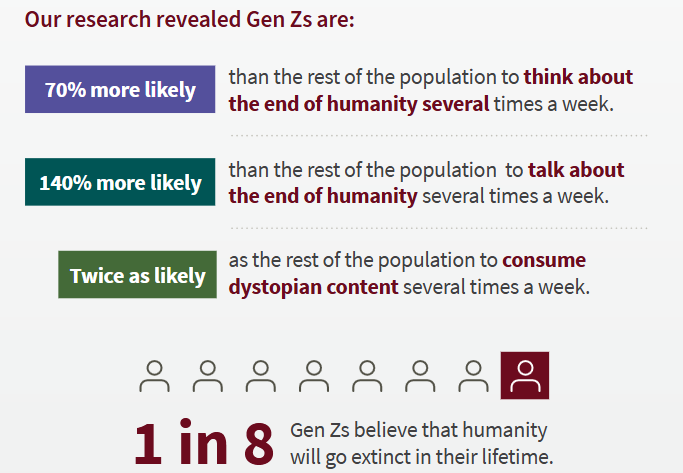
Notably, Gen Z employees are withdrawing from their RRSPs 12% more than millennials (born between 1981 and 1996) and 42% more than Gen X (born between 1965 and 1980) did at the same age, according to Canada Life 2024 claims data.
Helping Gen Z prepare for the future
These are concerning stats, and behaviours. And it makes sense that all the doomscrolling against a backdrop of gloom and uncertainty will have an impact on people trying to look optimistically to the future.
But HR can’t be expected to counteract climate change or lower inflation or political upheaval. So, how can they respond in a way that helps Gen Z better prepare for the future?
The Canada Life report has some sensible suggestions:
Reframe the moments that matter:
- Highlight the positive benefits of saving while acknowledging that Gen Z’s reality and short-term priorities are different from those of previous generations.
- Build trust by demonstrating when and how money or specific savings tools can help, and where their limits are.
- Position long-term savings as a way to stay adaptable across a range of possible futures.
Highlight the power of “something is better than nothing.”
- With contribution matching, start by outlining the full match available, but emphasize that it’s easy to make changes or that starting with just 1% is a great first step.
- Demonstrate the power of compounding: small savings over time, such as $20 compounded over 25 years.
Make it easy to find good information:
Social media may be popular with younger generations, but it isn’t always reliable. Employers should provide easy-to-find, tailored information – “bite-sized, engaging – and tailored to their life stage,” says the report.
Reframe saving for a new generation
Traditionally, saving for the long term has been geared toward retirement, but that may not resonate with Gen Z. Instead, “consider reframing saving around adaptability and resilience.” Lean into the message that their savings give them options and there are resources to help them adapt to an uncertain future.
Add flexibility to retirement and savings plans:
- Payroll deductions can help Gen Z employees contribute automatically in a way that fits their budget, while employer matching or other plan features can help their savings go further.
- Offer a tax-free savings account (TFSA) alongside a retirement plan to make saving feel more accessible for employees who aren’t ready to lock in their funds for the long term.
- Allow employees the flexibility of directing their personal contributions to shorter-term savings while keeping employer contribution towards longer-term savings or core products.
Reframing the message
My son officially started his first full-time job yesterday, having worked through a co-op year and graduated in the spring. Despite his youthful post-apocalyptic cravings, he’s now looking forward to working hard and making money, getting married and having kids, and living a full life. I’ll be honest, he’s still a survivalist at heart, but with a good dose of humour to balance things out.
We’ve talked to him about saving for the future and we still have work to do there. But it’s helpful to know these existential thoughts could be a factor in his financial planning, so I’ll be sure to reframe the messaging if needed.