Statistics Canada's latest job vacancy data tells two stories that are really one story

According to the latest StatsCan report, Job vacancies barely moved in the second quarter, holding at 510,200 nationally. Underneath that flat headline number are two trends that point the same direction, and HR leaders should read them together rather than separately, as they add up.
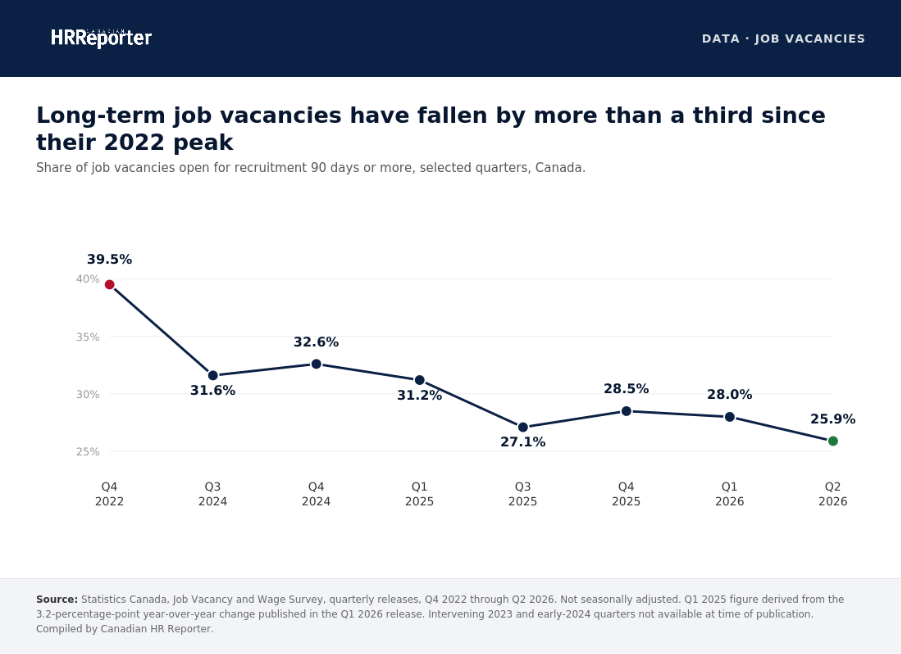
The share of vacancies that had gone unfilled for 90 days or more, Statistics Canada's marker for genuinely hard-to-fill roles, dropped to 25.9% in the second quarter.
That's down from 28.0% in the first quarter, and well off the 39.5% peak recorded in the fourth quarter of 2022, when employers were fighting over a much smaller pool of available workers.
This isn't happening because demand for workers collapsed. Total labour demand, the combined count of filled and vacant positions, was actually up 1.0% year over year, driven by a matching rise in payroll employment.
Employers are hiring about as much as before. They're just not struggling as hard to fill the roles they post. The unemployment-to-vacancy ratio, at 3.0 unemployed people per opening, is essentially flat quarter over quarter and down slightly from 3.1 a year ago, another sign the market has settled rather than tightened or slackened dramatically.
Job seekers have less leverage
Here's the other half of the picture. The average hourly wage offered on vacant positions rose just 2.0% year over year, to $28.55, in the second quarter.
That's down from 2.2% growth in the first quarter, and a long way from the 7.6% peak reached in the third quarter of 2024.
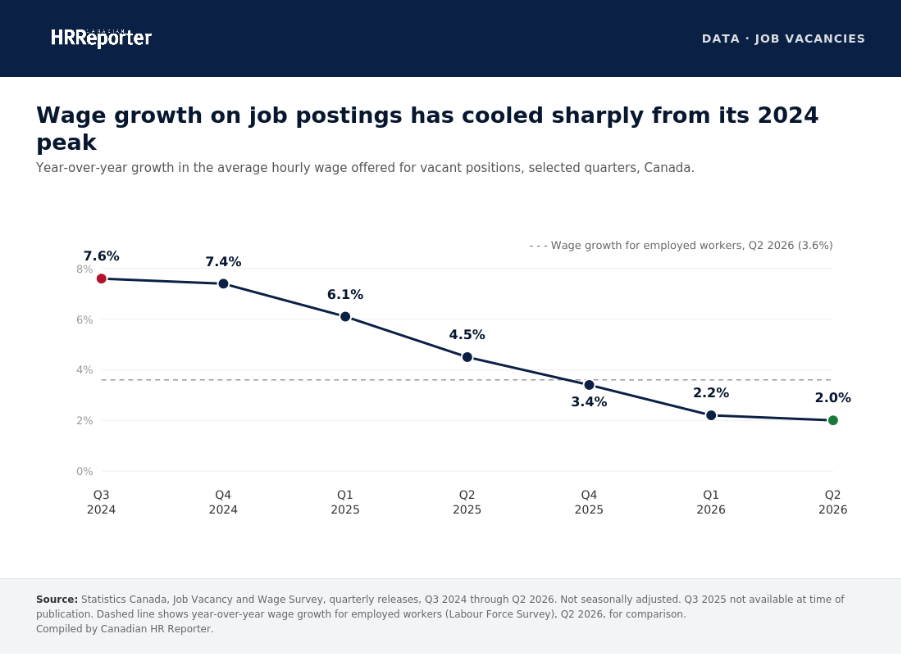
Compare that with what's happening to people who already have jobs. Wages for employed workers overall, as measured by the Labour Force Survey, grew 3.6% over the same period, following 4.0% growth in the first quarter.
In other words, the wages on offer for someone considering a move are now growing more slowly than the wages of people who stay where they are. That's a reversal of the dynamic that defined the labour market from 2022 through 2024, when the fastest way to a raise was often to leave.
None of this means switching jobs no longer pays off in absolute terms; a new offer can still beat a current salary in dollar terms even if its year-over-year growth rate is slower. But the momentum has shifted, and momentum is what shapes how confidently candidates negotiate and how urgently employees consider leaving.
Why these are linked
Both trends come from the same underlying shift: employers aren't competing as hard for talent as they were two years ago. When competition for workers cools, two things happen at once. Postings get filled faster, because there's less of a bidding war over the same candidates. And wage offers grow more slowly, because employers don't need to outbid each other the way they did when vacancies sat open for months.
That's consistent with what the Bank of Canada has described as a "low-hire, low-fire" market: employers aren't laying people off in large numbers, but they aren't chasing talent aggressively either. Fewer open roles competing for the same candidates means less pressure on wages, and less pressure on wages means less incentive for anyone to move, which in turn keeps vacancies from piling up.
It's a stable equilibrium, just one that favours employers more than the one Canadian HR teams got used to during the pandemic-era hiring crunch.
What this means for HR planning
A few things worth acting on rather than just noting.
Recruiting timelines can reasonably shrink. With long-term vacancies down by more than a third from their 2022 peak, budgeting for months of open-role costs on the assumption that hiring will be a slog is now working against you, not for you. Revisit time-to-fill targets that were set two or three years ago under much harder conditions.
Retention doesn't get easier just because hiring does. A cooler wage-offer environment reduces the financial incentive for your employees to leave, but it says nothing about engagement, career growth, or the other reasons people quit. Don't mistake a quieter external labour market for a guarantee that your own attrition risk has gone away.
Be careful with compensation benchmarking that's still anchored to 2024. If your organization's pay bands or offer strategy were built when offered wages were growing at 6% or 7% a year, they're now calibrated to a market that no longer exists. Comparing new offers against that older baseline risks overpaying relative to what it now actually takes to win a candidate.