Canadian workers, job seekers altering personalities to fit workplace culture, finds survey

Canadian HR professionals may need to dig a little bit deeper to get to know the people they are interviewing before welcoming them onboard.
That’s because 68 per cent of job seekers say they have changed aspects of their personality to fit workplace culture.
And 59 per cent say their at-work personality is very different from who they are in everyday life, reports Express Employment Professionals.
Personality is part of assessment
Personality management is now widely viewed as a professional skill tied to career outcomes, finds the Express survey of 508 Canadian adults who are employed but looking for a new job or not employed and looking for work, from May 19 to June 8, 2026.
Over eigt in 10 (84 per cent) job seekers called adapting to workplace culture a core professional skill, and 89 per cent said employees unwilling or unable to adjust are less likely to stay with a company long term.
Personality factors into how employees are evaluated and whether they advance.
Nearly all hiring managers (94 per cent) and job seekers (91 per cent) say it shapes perceptions of performance. Meanwhile, 98 per cent of hiring managers and 92 per cent of job seekers believe a positive or approachable personality can accelerate career advancement.
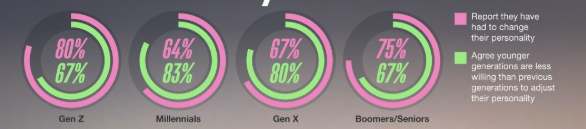
A majority of job seekers nonetheless disputed the fairness of that standard. More than half (53 per cent) called it unfair to expect personality adaptation, and 52 per cent said personality has nothing to do with their ability to do the job — a view held by 62 per cent of Gen Z, 52 per cent of millennials, 47 per cent of Gen X and 30 per cent of boomers and seniors.
Workers are becoming “statistically boring” amid artificial intelligence (AI) adoption surge, according to one expert. And tools such as ChatGPT might be used to fake personality tests – and that is so easy to do, according to a previous report.
Support gap and employer response
Formal guidance has not kept pace with the pressure to adapt. Just 41 per cent of job seekers said their employer provides guidance on managing or developing their personality for a professional setting, with Gen Z (52 per cent) and millennials (42 per cent) more likely to receive it than Gen X (33 per cent) or boomers and seniors (25 per cent).
“Strong teams do not require everyone to have the same personality, but they do depend on people being able to communicate, adapt and work through differences,” says Bob Funk Jr., CEO, president and chairman of Express Employment International. “Clear expectations and practical guidance can help employees grow while giving job seekers a better understanding of where they can contribute without losing what makes them effective.”
HR professionals should factor personality into AI training and adoption strategies as employees' curiosity, caution or skepticism — not just the technology itself — may determine who embraces AI and who resists it, according to a previous report.
Who’s the best fit for your organization?
Here are five personality traits/profiles that current research and workforce reports link to strong organizational fit in 2026:
|
Personality Trait / Type |
Why It Fits Organizations in 2026 |
Source |
|
Conscientiousness/Dutifulness (Big Five) |
A 30-year integrative review found conscientiousness remains the single strongest predictor of job performance across virtually all occupations. It holds up consistently even as workplace context shifts, which is why it's still treated as a "universal" hiring filter. |
Frontiers in Psychology, "Personality, capability, and context: a 30-year integrative review... of the Big Five" (2026) |
|
Emotional Stability / Resilience (low neuroticism) |
Resilience jumped from 7th to 1st place as the most-assessed personality trait in talent-acquisition data in Q2 2025, as organizations prioritized emotional stability under pressure. The World Economic Forum's Future of Jobs Report 2025 similarly ranks "resilience, flexibility and agility" as the second most essential core skill among employers, just behind analytical thinking. |
Compono, "Work Personality by Job Function Data: The 2026 Guide to Team Design"; Economic Forum, Future of Jobs Report 2025 |
|
Openness to Experience |
Openness shows the largest occupational differences of any Big Five trait, sharply separating strong performers in creative, artistic, and investigative roles. It is increasingly valued as organizations lean on AI-driven reinvention of workflows, which rewards curiosity and comfort with novelty. |
PsychometricResearch.com, "Best Careers for Your Big Five Profile: 2026 Guide" |
|
Extraversion / Leadership & Social Influence |
Extraversion continues to predict success in sales, management, and public-relations-style roles requiring persuasion and coordination. LinkedIn's Skills on the Rise 2026 report found human-centred skills such as leadership influence and cross-functional collaboration are climbing just as fast as technical AI skills. |
PsychometricResearch.com (as above); ETS Insights & Perspectives, summarizing LinkedIn's Skills on the Rise 2026 |
|
Adaptability (a cross-cutting behavioural trait) |
LinkedIn data shows adaptability and conflict mitigation made up roughly half of its "fastest-growing skills" list, alongside AI literacy, as roles change faster than job descriptions can be rewritten. This trait draws on both high openness and low neuroticism, letting employees pivot without a drop in performance. |
CNBC, "These are the fastest-growing skills in the U.S., according to LinkedIn" (2026) |