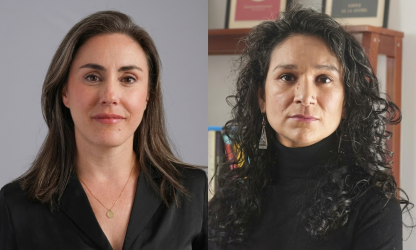
HR exec discusses importance of HR certification, mentorships, total rewards and asking for help

Isioma Coker didn't set out to be an HR leader. She set out to be an engineer.
"I love solving problems, and so I thought that engineering was where I needed to go."
But after a year at Baylor University in Texas, Isioma wasn't so sure.
"I never went into university thinking I wanted a job," she says. "I always went in wanting a career. And I'm like, ‘If I haven't even done the five years, and I feel this way after year one, how am I then supposed to complete this degree and then work in this area for the rest of my life?’"
Isioma went to the career services centre. They gave her a Myers-Briggs test and HR came up as a match. She signed up for HR courses that semester — and never looked back: “I was like, ‘Yeah, this is where I'm supposed to be.’”
The change in plan reflects the character of Isioma, who is now at SaskTel as HR director (total rewards, strategic planning, performance management and learning and development).
"One of the things that I've been fortunate about most of my life," she says, "is I've never had a problem putting a hand up and saying, ‘I need help.’ I've never had a problem saying, ‘Hey, I don't think this is working.’ If I get into something and it doesn't feel right or it's not working, I always opt out quickly."
HR education: An eye on development
At Baylor, Isioma was already orienting toward community as much as curriculum — Delta Sigma Pi, the African Students Association, the Baylor Association of Human Resources, the Society of Human Resource Management (SHRM) student chapter, and the Association of Black Students.
She followed her BBA with an MSc in Human Resources and Industrial Relations at Alliance Manchester Business School, where she became an associate member of the CIPD — the beginning of a relationship she has sustained ever since. As of July 2026, she holds Chartered Fellow status, the institute's highest membership grade. She also holds the CPHR designation from CPHR Saskatchewan and sits on its board.
"Once you choose to go through the certification route, it really forces you to consistently keep an eye on your development," she says.
"It's very easy to get bogged down by the day to day — whether it's the operational side of your business or the strategy side — and to keep that lens and just be insular. Not because you don't want to learn, but there's nothing… kicking you or forcing you to do it."
Isioma says she finds the Canadian approach to professional credentials somewhat different.
“It’s a nice-to-have which is very interesting to me because I'm like, ‘But how do you then stay ahead of the trends in terms of best practices? Where are you looking to get your research to know what's going on, so you bring that into your organization?’"
"A lot of the things that I've been able to introduce, whether it was at Shell or here, some of them have come from the peer learnings that I've joined from a CIPD perspective."
The P&G foundation in HR
Before Manchester, there was a mentor — the head of HR at Schlumberger — who told Isioma she should look for a fast-moving consumer goods company to start her HR career, “because they will give you a lot of exposure quickly. You'll be able to learn a lot. And you'll be able to fail fast and fail forward.”
Isioma took the advice and joined Procter & Gamble in Lagos.
"The biggest gift in my career was starting at P&G," she says. "They treat every employee, especially when you join fresh out of whatever degree it is, like a blank slate. They always tell you: ‘We hired you because you're a culture fit, and then we want to teach you everything.’"
The result was early, substantial responsibility — more, Isioma says, than most organizations would have trusted a recent graduate with.
"I learned in the deep end, but it’s not like I was thrown in the deep end and I didn’t have any safety railings. I had great people that I was working with, great systems to learn from, people who were willing to kind of pour into me."
Eleven years in HR at Shell
In 2013, Isioma joined Shell — and she would end up staying with the company for over 11 years, starting as an HR business partner and leaving as a senior HR business partner.
“It was amazing to move from one global giant to another, to learn about HR in a different industry."
But there were some adjustments that needed to be made.
"You come from P&G — very margin-driven, very bottom line in terms of everything it is that you're doing — to a company where it's not that they don't focus on the bottom line, but it's different because they’re dealing with the capital projects and the projects they're dealing with are so much bigger in terms of dollar value,” she says, citing differences in skills and recruiting.
One of the biggest learnings for Isioma from Shell was how to take global designs and implement them locally, she says.
“Everyone was held to the same standard in terms of ‘This is what it was. We want the Shell experience to be as similar as possible regardless of where it is.’ But how does that work for your country without taking away from what the global HR design is supposed to be?"
She also learned to find her voice in a large, complex, unionized environment — skills in labour relations and compensation that would follow her across the Atlantic.
Joining a Crown corporation
Isioma was headhunted for SaskTel in 2024. The timing aligned with something she had been quietly working through.
"I had moved to Canada. My role was remote so I didn’t have a team that I was working with in-person. I was at home. And I was like, ‘OK, if I really want to integrate into Canadian society, I probably want to work in a Canadian company — especially in the province that I'd chosen to live in.’"
Plus, SaskTel was in an interesting position with a new CEO.
"They were thinking about their strategic plan in terms of really transforming their business. And so I was like, ‘This would be an exciting time, an exciting challenge to take on.’"
Isioma admits she wasn’t overly familiar the Crown corporation model at first.
"Coming in and seeing the value that a Crown is, and what it means to the people of Saskatchewan — it was like, ‘Oh… I'm not just working a for-profit organization, I'm actually also working to serve the people of Saskatchewan.’”
She joined as HR director with responsibility for labour relations, compensation and benefits, and job evaluation. In August 2026, Isioma's portfolio changed to total rewards, strategic planning, performance management, and learning and development — a different breadth of the HR function.
Healthcare constraints in Canada
Moving from Nigeria to Canada, Isioma found there are more similarities than differences, she says.
"What a lot of people don't realize is Nigeria was colonized by the British, the same way Canada was colonized by the British. And most HR practices are based off of law — and Nigerian law and Canadian law are both based off of the common law. So, there's a lot of similarities in terms of the HR practices… in dealing with unions and the labour relations movement… accommodations."
Where Isioma has noticed friction is in Canada's approach to healthcare privacy and the constraints on information sharing.
"I don't know that they necessarily help the employee and the company to give the employee the support that they require,” she says.
"There are things that are done that are actually worsening the condition of the employee unintentionally, just because there's that vacuum of information."
The system can breed distrust, says Isioma, as the parties stand against each other, with no assumptions of positive intent — especially with mental health.
"If there's already a stigma — ‘I'm going to be discriminated against’ — they may not be willing to come forward and share. And so you don't equip the company or the manager with the right tools to know: ‘How do I actually help this person?’"
Making total rewards count at SaskTel
SaskTel is also focused on finding top talent in a competitive market, says Isioma, which means working on the employee value proposition (EVP). The team launched a total rewards campaign to help employees understand the full picture of what they received. The engagement survey that followed showed improvements, highlighting that compensation is rarely the real driver of turnover.
"Job satisfaction actually plays a bigger role… People spend most of their time at work, and when they come to work, they want to work on stuff that is meaningful, stuff that makes them feel important, stuff that makes them feel valued,” she says.
The risk for mature organizations is quiet neglect, according to Isioma.
"You have someone who's been doing a job for 10 years, and you're like, ‘Oh, Sarah knows what she's doing. She's got everything under control.’ When last did you have a conversation and say, ‘Hey, is this role still fulfilling you? Are you still happy in this job? Is there more you would want to do?’”
In most organizations, advancement opportunities are limited, so it’s about adding more projects or working to enrich a person’s role, she says.
"Once people feel like the company sees them and is trying to lean into them, then they stay. But when they feel like ‘I’m on an island by myself and I’m just trying to figure it out’ — that's typically when money is the biggest driver, and they're just looking for who's going to pay them the biggest check."
Isioma returns often to a formulation she picked up at Shell.
"One of my former managers said: ‘You always want employees who are able to go but happy to stay. And that's the philosophy you should design around,’” she says.
"You want people who are competitive, who could potentially be headhunted, who could apply for a job and get it — because that shows you have the best talent. But you want them to make an active choice every day to work for your company."
On AI and the skills question
Another big focus area for SaskTel is figuring out AI and how it ties into the workforce and future skills, according to Isioma.
"We are very big on trying to make sure that we are looking at that, seeing where those impacts are, figuring out where we would need to reskill our current workforce, what we can do to help them with the AI adoption, and how we can actually use it to alleviate some of the work pressures that we experience at work."
The question underneath that is whether HR itself is keeping pace and supporting the organization.
"Are we as HR professionals skilled with the right skill sets to be able to support the business and where the business is trying to go?" she says.
"How do we get ahead? How do we think strategically to get in front of that to be like, ‘OK, where are they going? What HR services are we providing and what HR services will we need to provide that maybe we don't provide today as well?’"